

Quantifier et segmenter les flux de matières premières utilisées en France par l’alimentation animale
Chapeau
Les enjeux multiples autour de l’alimentation des animaux d’élevage mettent en lumière un besoin de repères partagés autour de la question « qui consomme quoi ? ». Le Groupement d’Intérêt Scientifique Avenir Élevages (www.gis-avenir-elevages.org) et ses partenaires proposent une méthode pour quantifier, à l’échelle de la ferme France, les flux d’aliments et de fourrages de leur production jusqu’à leur utilisation par les animaux.
Introduction
Si la dépendance de la France et de l'Union européenne aux importations de matières premières riches en protéines (soja, tourteaux en premier lieu) est ancienne et n'a que très peu été enrayée par la Politique Agricole Commune (PAC) (Hache, 2015), les enjeux auxquels fait face l'alimentation des animaux d'élevage en France ne sont pas uniquement géopolitiques. En effet, les attentes sociétales relatives à la durabilité de l'alimentation des animaux sont de plus en plus prégnantes : la demande pour des produits issus d'animaux nourris sans OGM augmente et ce critère intervient dans de nombreux cahiers des charges (SNIA, 2020), les considérations environnementales autour de la déforestation importée par le biais du soja sont régulièrement au centre de l'actualité (Ministère de la transition écologique et solidaire, 2018) et la compétition entre l'alimentation humaine et l'alimentation animale est régulièrement questionnée (Laisse et al., 2018). Parallèlement, l'élevage fait face à une variabilité accrue des disponibilités en matières premières d'une année à l'autre, en fourrages notamment (Agreste, 2018), en lien avec des épisodes climatiques de plus en plus extrêmes. Dans ce contexte pluriel, l'autonomie alimentaire de l'élevage français, surtout en protéines, revient très régulièrement dans le débat public. Les pouvoirs publics et les acteurs des filières mènent de nombreuses réflexions et actions afin d'améliorer le taux d'autonomie, avec comme exemple le plus récent le Plan protéines 2020 intégré par le gouvernement français dans le Plan de relance suite à la pandémie de Covid-19.
Face à ces enjeux multiples, les références sur les utilisations de matières premières par les filières animales françaises sont particulièrement utiles. Si les tonnages et la typologie des matières premières (MP) utilisées par les fabricants d’aliments du bétail (FAB) font l’objet d’enquêtes statistiques régulières - 21,8 Mt en 2015 (Agreste, 2017) -, il n’existe pas de recensement global intégrant également les MP utilisées directement à la ferme par les éleveurs (MP autoproduites ou achetées à l’état brut, et les fourrages).
De nombreux travaux de recherche ont proposé des estimations des utilisations de MP (fourrages inclus) par les filières animales à différentes échelles du globe, nécessitant à chaque fois la mobilisation d'un très grand nombre de données (Herrero et al., 2013 ; Hou et al., 2016 ; Dronne, 2018). À l'échelle de la France, Agreste (2013) a évalué les volumes moyens de MP consommées par l'élevage français pour la période 2007-2009 et la segmentation des utilisations pour certaines filières animales. Par ailleurs, Dronne (2018) a proposé une évaluation des ressources et des consommations de protéines issues de MP en 2011 en France et dans l'Union européenne en combinant de nombreuses statistiques. Ce dernier travail a également estimé par modélisation les utilisations de protéines issues de grandes catégories de MP pour trois grandes filières animales (herbivores, porcs, volailles).
Dans le prolongement de ces recherches, le GIS Avenir Élevages et FranceAgriMer ont souhaité réactualiser et compléter ces références en proposant une méthode reproductible pour dresser le panorama global des flux de matières premières utilisées en alimentation animale (grains, coproduits et fourrages) dans le système alimentaire français depuis les ressources jusqu'aux différentes voies de valorisation (alimentation humaine ou animale, export, production d'énergie…). L'objectif était de construire une méthode qui soit par la suite mobilisable pour mettre en œuvre un observatoire pérenne des flux de MP. Pour conduire ce travail, une première étape a consisté à rassembler et à analyser l'ensemble des données disponibles produites par les acteurs publics (ministères, instituts de recherche) et professionnels (industriels, interprofessions, instituts techniques). Dans une seconde étape, pour mettre en cohérence l'ensemble du jeu de données et estimer les flux une méthode de réconciliation de données avec optimisation sous contrainte (Courtonne et al., 2015), déjà utilisée auparavant pour décrire les flux de biomasse dans la filière forêt bois (Lenglet et al., 2017), a été utilisée. Cette méthode permet de quantifier les flux en tenant compte des incertitudes pouvant être évaluées sur les données disponibles et en estimant les données manquantes.
Cet article a pour objectif de présenter la méthode mise en œuvre, les principaux résultats obtenus sur une année donnée et de les discuter en tant que repères sur la nature et les tonnages de matières premières et de protéines consommés en France par chaque filière animale. Dans une première partie, les sources de données utilisées et la méthode de réconciliation de données par optimisation sous contraintes seront présentées. Les principaux résultats obtenus sur les flux de fourrages, de matières premières concentrées
1. Construction de la méthode « flux de matières premières »
La méthode proposée repose sur quatre étapes : i) la définition de la structure de la filière (produits, secteurs, flux pouvant exister) ; ii) la collecte des données existantes ; iii) la réconciliation des données, et iv) l’analyse et la visualisation des résultats, la confrontation avec des experts et les itérations sur les étapes i), ii), iii). Les paragraphes suivants détaillent les principaux éléments de ces quatre étapes.
1.1. Cadre général et périmètre de l’étude
L’année 2015 a été retenue pour construire la méthode d’estimation des flux de matières premières en France métropolitaine. Elle a été choisie car elle correspond aux statistiques consolidées les plus récentes sur les utilisations de matières premières par les fabricants d’aliments composés pour animaux d’élevages (Agreste, 2017). La prochaine enquête de ce type portera sur l’année 2020, avec publication des résultats courant 2022.
Les consommations de l'ensemble des MP concentrées et des fourrages (encadré 1) ont été segmentées selon 11 catégories d'élevages associés à des espèces animales : bovins laitiers et mixtes (BL&M), bovins à viande (BV), ovins laitiers (OL), ovins à viande (OV), caprins (Ca), porcs (P), volailles de chair (VC), volailles de ponte (VP), palmipèdes gras (PG), équins (Eq) et lapins (L). La dénomination « bovins laitiers et mixtes » regroupe l'ensemble des Unités Gros Bétail (UGB) bovines présentes sur les exploitations ayant des vaches laitières, dont on ne connaît les consommations d'aliments que de façon globale (Devun et al., 2012) à partir du dispositif de fermes de référence INOSYS-Réseaux d'élevage (https ://chambres-agriculture.fr/informations-economiques/inosys-references-systemes/inosys-reseaux-delevage/). Elle inclut ainsi les bovins à viande (vaches allaitantes, engraissement) présents dans les exploitations dites mixtes (bovins laitiers et viande).
Encadré 1. Les matières premières et les fourrages considérés.
Les MP concentrées dont l’emploi a été détaillé dans cette étude sont issues de 17 filières végétales (incluant les coproduits générés à chaque étape de transformation) :
Blé tendre, orge, maïs, blé dur, triticale, avoine, seigle, sorgho, pois, fève, lin, lupin, soja, colza, tournesol, coproduits betteraviers, luzerne déshydratée.
En intégrant les coproduits générés pendant les étapes de transformation de ces 17 filières végétales « concentrées », l’étude a porté sur les flux d’une cinquantaine de MP concentrées utilisées en alimentation animale.
Les fourrages ont été répartis en quatre catégories :
Ensilage de maïs, herbe pâturée, herbe conservée et autres fourrages.
D’autres MP couramment utilisées en alimentation animale, telles que les aliments vitaminiques et minéraux ainsi que d’autres coproduits, dont des sous-produits d’origine animale, n’ont pas été exclus, mais regroupés dans une catégorie intitulée « autres MP ».
Les aliments d’allaitement n’ont pas fait partie du champ de l’étude.
Enfin, il est important de bien considérer ce travail comme le point de départ d’une démarche d’amélioration continue de la connaissance. Il vise à fournir un premier bilan, avec de nombreuses limites et points de vigilance comme nous le discuterons en section 6, et permet également de pointer les éléments sur lesquels il serait intéressant de focaliser les efforts statistiques.
1.2. Les données mobilisées
a. Les données disponibles sur les aliments
Pour chaque MP concentrée, les données disponibles ont été recensées et analysées pour décrire son bilan matière. De la production aux utilisations, les sources et la nature des données utilisées ont été les suivantes (détaillées dans le rapport de Cordier, 2019) :
i) La production (Statistique Agricole Annuelle) ; ii) la collecte des grains (États 2, 2015 de FranceAgriMer) ; iii) les stocks chez les organismes stockeurs et opérateurs commerciaux (États 2, 2015 de FranceAgriMer) ; iv) le commerce extérieur (douanes françaises) ; v) les pertes (Duc et al., 2015 ; Fine et al., 2015 ; Juin, 2015) ; vi) Les semences fermières (enquête culturale du SSP, 2015a,b ; SICASOV ; GNIS ; Duc et al., 2015 ; FOP) ; vii) l'intraconsommation et les stocks à la ferme (Bilan FranceAgriMer) ; viii) l'incorporation de grains par les fabricants d'aliments du bétail (États 13, 2015 de FranceAgriMer ; enquête MPAA d'Agreste) ; ix) les statistiques des fabricants d'aliments sur la répartition de la production par espèce animale (SNIA-Coop de France, 2015) ; x) la production et les utilisations des coproduits (Réseda, SIFCO, Interprofessions animales ; enquête MPAA d'Agreste) ; xi) la production et l'utilisation sous forme de « Petfood » (FACCO, 2016) ; xii) l'utilisation pour l'alimentation humaine (États 8, 2015 et 8N de FranceAgriMer).
Les références ne présentaient pas toujours une couverture totale de toutes les filières végétales étudiées et de nombreux manques statiques ont été constatés (Cordier, 2019). La méthode de réconciliation des données par optimisation sous contraintes a permis d’estimer les données manquantes.
En ce qui concerne les fourrages, les données de production se sont basées sur les statistiques de production fourragère française de 2015 (SAA-Agreste, 2020b). Les modes d'utilisation des prairies, tels que décrits dans l'enquête sur les pratiques culturales (Agreste, 2011), ont été utilisés. Le mode de récolte des fourrages issus des prairies a été estimé à partir des travaux de Devun et Legarto (2011), les pertes de conservation des fourrages à partir des données de Dulphy (1987) et Dulphy et Martin-Rosset (2001), les refus de distribution à partir des travaux de Bossis et al. (2012) pour les caprins et de Wheeler (1993) et Rouillé (2012) pour les autres herbivores, et les refus de pâturage à partir des travaux de Hoden et al. (1991).
b. Les données de consommations par les animaux
Les travaux, bases de données et outils internes des instituts techniques animaux (IDELE, IFIP, ITAVI) ont été mobilisés pour évaluer la composition des rations dans leur ensemble pour les 11 catégories d’animaux identifiées. Ces rations distinguent les aliments complets achetés auprès des fabricants d’aliments du bétail, et la FAF (fabrication d’aliment à la ferme), matières premières utilisées entrant dans la catégorie des intra-consommations (IC - matières premières produites à la ferme et consommées par les animaux) ou du direct élevage (DE - matières premières achetées par les éleveurs en l’état brut).
Les références utilisées pour décrire l'alimentation des bovins, ovins et caprins proviennent respectivement des travaux de Devun et al. (2012), Jousseins et al. (2014) et Bossis et al. (2015), à partir du dispositif de fermes de référence INOSYS-Réseaux d'élevage. Ces références alimentaires concernent aussi bien les consommations de fourrages que celles de MP concentrées. Les rations individuelles ont ensuite été pondérées en fonction de la représentativité des différents systèmes d'élevage au niveau national et multipliées par le cheptel présent en 2015. Pour les bovins, les données d'UGB utilisées sont issues du traitement par l'IDELE de la Base de Données Nationale d'Identification des bovins (BDNI) et du Système Professionnel d'Information de l'Elevage (SPIE). Ainsi, en 2015, le cheptel des exploitations bovines laitières et mixtes était évalué à 6,70 millions d'UGB et le cheptel des exploitations bovins viande à 6,09 millions d'UGB. Pour les ovins, le cheptel retenu se base sur la statistique agricole annuelle de 2015 (SAA-Agreste, 2020a) convertie en UGB, soit 587 milliers d'UGB ovines pour le cheptel à viande et 209 milliers d'UGB pour le cheptel laitier. Le cheptel caprin retenu pour les calculs (1,23 million d'animaux dont 850 000 femelles ayant mis bas) provenait également de la statistique agricole annuelle de 2015 (SAA-Agreste, 2020a).
Pour la filière porcine, l’alimentation des animaux a été segmentée sur le territoire de France métropolitaine en cinq types de systèmes d’alimentation de porcins : aliment complet FAB, aliment complémentaire FAB, FAF Maïs Grain Humide, FAF sèche et FAF coproduits (Berthelot et Badouard, 2011). Les contraintes spécifiques à la FAF ont été prises en compte, par exemple un nombre limité de matières premières utilisables en raison des contraintes d’équipements des élevages en FAF (nombre de silos) ou de leur localisation. Afin de prendre en compte les substitutions de matières premières, en fonction de leur prix relatifs et valeurs nutritionnelles, la composition des rations (porcs à l’engrais, truies, porcelets) a été estimée au moindre coût à partir du logiciel de formulation Porfal (développé par l’IFIP), en tenant compte des prix de marché mensuels des matières premières observés durant les 12 mois de l’année 2015, pour chacun des cinq systèmes d’alimentation. La pondération en volumes de chacun de ces cinq types de systèmes d’alimentation a ensuite permis d’extrapoler les consommations des porcins à l’échelle de la France métropolitaine, à partir également des indices de consommation nationaux moyens obtenus en Gestion Technico-Economique (IFIP, 2016), pour correspondre à la production indigène brute de 2015, calculée dans les bilans annuels de FranceAgriMer, soit 2,237 millions de tonnes équivalent carcasse.
Pour les filières avicoles et cunicole, l’évaluation de la composition des rations a été réalisée pour une situation nationale moyenne et s’est appuyée sur les bases des indices mensuels de l’ITAVI, qui estiment des coûts alimentaires pour le poulet de chair standard, le poulet Label Rouge, la dinde, la pintade, la poule pondeuse, le canard à rôtir, le canard gras et le lapin (ITAVI, 2017). Les parts relatives de chacune des MP utilisées ont été évaluées en fonction des prix mensuels des MP en 2015 pour avoisiner une formulation au « moindre coût » de l’aliment. Les consommations individuelles ont ensuite été extrapolées au nombre d’animaux nourris durant l’année 2015, évalués également d’après les indices de productivité des enquêtes de production de l’ITAVI (ITAVI, 2016 ; Hurand, 2016) et des bilans annuels de FranceAgriMer, soit 1,66 milliards de volailles de chair (poulet et coquelet, chapon, dinde, pintade, canard à rôtir), 95 millions de volailles pondeuses (poule et poulettes), 57,1 millions de palmipèdes gras et 43,4 millions de lapins.
Par manque de références bibliographiques, l’évaluation des consommations alimentaires des équins a fait l’objet d’hypothèses : 50 % des besoins en matière sèche des animaux sont comblés par le foin et la paille alimentaire (dans un rapport de 80 % pour le premier et 20 % pour la seconde), le pâturage représente ensuite près de 45 % des apports puis les MP concentrées comblent les 5 % restants. Pour les besoins de l’étude, l’Institut Français du cheval et de l’équitation (IFCE) a évalué à 1,1 million le nombre d’équins (y compris poneys et ânes) présents sur le territoire français en 2015.
Pour les filières porcine, avicole et cunicole, l’approche privilégiée de formulation au moindre coût précise la composition des rations entre les différentes matières premières (par exemple : blé, maïs, orge), ce qui fournit une information supplémentaire. Il est toutefois possible que cette approche moyenne (un seul type national pour les volailles et lapins, cinq types nationaux pour les porcins) sous-estime certaines contraintes de formulation liées par exemple aux disponibilités différentes des MP entre régions. Pour les herbivores, la diversité des systèmes étant très forte, les MP utilisées ont été détaillées au niveau des grandes catégories de MP (par exemple : céréales), mais pas au niveau des régions. Le niveau de détermination des contraintes portant sur les besoins alimentaires en MP est donc hétérogène entre monogastriques et herbivores.
La composition des rations en FAB a donc été estimée de manière indépendante pour plusieurs espèces (porcins, aviculture en particulier) mais pas pour toutes. L’enquête d’Agreste (2017) sur les utilisations de matières premières en alimentation industrielle détaille les utilisations selon la spécialisation des établissements mais pas selon les espèces de destination de chaque aliment fabriqué. Afin de compléter ces informations, nous avons utilisé les résultats fournis par le modèle « Prospective Aliment » du Céréopa (2016), qui ont permis d’évaluer la composition des aliments issus des FAB pour les filières porcs, bovins laitiers et mixtes, et bovins à viande (aliments complets et complémentaires) ainsi que la composition d’un aliment composé (sans distinction complet ou complémentaire) pour les filières volailles de ponte, volailles de chair, palmipèdes (gras et chair confondu), lapins et ovins-caprins. Le modèle tient compte des prix mensuels des MP et des spécificités régionales en matière de prix et disponibilités des matières premières.
1.3. La réconciliation des données par optimisation sous contraintes
a. Principe de la réconciliation des données par optimisation sous contraintes
Le système étudié dans l’étude est le « feed system » français, représenté comme un ensemble composé de matières, d’opérations et d’échanges. L’analyse des flux de matières qui est utilisée dans l’étude consiste en une quantification des flux des différentes matières échangées entre les différentes opérations, appelées également nœuds du système. Les flux des diverses matières entrantes et sortantes de chaque nœud n’étant connus que de manière partielle dans les sources statistiques, la réconciliation des données est la méthode employée pour rendre cohérentes entre elles ces données et disposer ainsi, au final, d’un ensemble d’informations cohérentes sur le « feed system ».
La réconciliation des données peut être définie comme le procédé permettant de passer de données lacunaires et/ou incohérentes entre elles (car provenant de sources multiples) à un bilan cohérent respectant certaines contraintes comme la conservation de la masse. Mathématiquement, il s'agit de minimiser l'écart entre données d'entrée (collectées) et données de sortie (résultats) du bilan en tenant compte de la fiabilité des sources (une donnée plus fiable devant moins être modifiée qu'une donnée peu fiable) (Kopec et al., 2016). La réconciliation des données par optimisation sous contraintes permet ainsi de tenir compte des incertitudes autours des valeurs d'entrée et d'estimer les valeurs manquantes (encadré 2). Ce principe est couramment utilisé pour réaliser des bilans matières de différents types de substances dans leur cycle de vie de l'extraction à la production et l'utilisation finale, comme les produits de raffinerie, les déchets (Cencic et Rechberger, 2008), les métaux (par ex., Bonnin et al., 2013), l'azote ou le phosphore (par ex. Boh et Clark, 2020).
Encadré 2. La réconciliation de données basée sur l’optimisation sous contraintes : entrées et sorties du modèle.
La réconciliation des données peut être définie comme le procédé permettant de passer de données lacunaires et/ou incohérentes entre elles (car provenant de sources multiples) à un bilan cohérent respectant certaines contraintes comme la conservation de la masse. Les données sont organisées au sein de Tableaux croisant les Emplois et les Ressources (TER). La table « emploi » indique quels secteurs consomment les produits, la table « ressource » indique quels secteurs produisent les produits. Chaque flux, qu’il soit renseigné ou non par les données collectées est soumis à une ou plusieurs contraintes. Une contrainte est une relation linéaire entre flux. Il existe en pratique 4 types de contraintes :
Des contraintes imposant des bornes minimum/maximum sur les flux :
Par exemple, on sait que la récolte totale de céréales est supérieure à 8 et/ou inférieure à 12 t de MS/ha ;
Des contraintes d’agrégation nécessaires pour permettre différents niveaux de détail dans le modèle. Ce sont des relations d’égalité :
Par exemple récolte totale de céréales = récolte de blé tendre + récolte des autres céréales ;
Des contraintes de conservation de la matière qui sont également des relations d’égalité ;
Des contraintes ad’hoc ajoutées pour mieux modéliser la filière : il peut s’agir de rendements de transformation :
Par exemple, pour 1 kg de blé tendre qui entre dans une meunerie, on sort 770g de farine, ou n’importe quelle autre relation reliant plusieurs variables (ex : au moins 20 % de ce qui est consommé est importé).
Les données initiales en entrée du modèle prennent la forme d’une valeur numérique à laquelle est attachée un coefficient d’incertitude. Ces coefficients ont été fixés (1, 5 et 10 %) après analyse de la fiabilité des différentes sources de données disponibles. Par exemple, une valeur d’entrée du modèle issue d’une enquête statistique robuste a été appréciée comme fiable et donc associée à un coefficient d’incertitude réduit. À l’inverse, une valeur d’entrée du modèle considérée comme moins fiable (par exemple, les consommations de céréales à la ferme qui sont estimées à partir de dire d’experts dans les bilans d’approvisionnement français) a été associée à un coefficient d’incertitude plus élevé.
La réconciliation des données aboutit à deux types de résultats issus de processus distincts : 1) une « valeur centrale » de chaque flux, obtenue par minimisation de la somme des carrés des écarts entre les valeurs d'entrée (données collectées) et de sortie du modèle (résultats), et 2) un intervalle de confiance encadrant la valeur du flux obtenu par simulation de Monte-Carlo (Courtonne et al., 2015).
Pour certaines variables dites « non-déterminables » ou « libres », la réconciliation des données ne peut aboutir qu’à un résultat sous forme d’intervalle.
Les schémas ci-dessous illustrent les résultats obtenus par la méthode de réconciliation selon les trois cas possibles, basées sur le même exemple : production totale de céréales = production de blé tendre + production d’autres céréales.
Dans chaque cas, le schéma de gauche correspond aux données d’entrée (collectées) et le schéma de droite correspond aux données de sortie du modèle (résultats).
1) Mise en cohérence de données redondantes
Dans ce cas, après étude bibliographique et analyse des sources statistiques, une valeur d’entrée du modèle (initiale) est disponible pour chaque flux du modèle. Une incertitude de 10 % est estimée sur ces valeurs par des experts. Le modèle propose les valeurs centrales finales et les intervalles de confiance pour chacun des flux.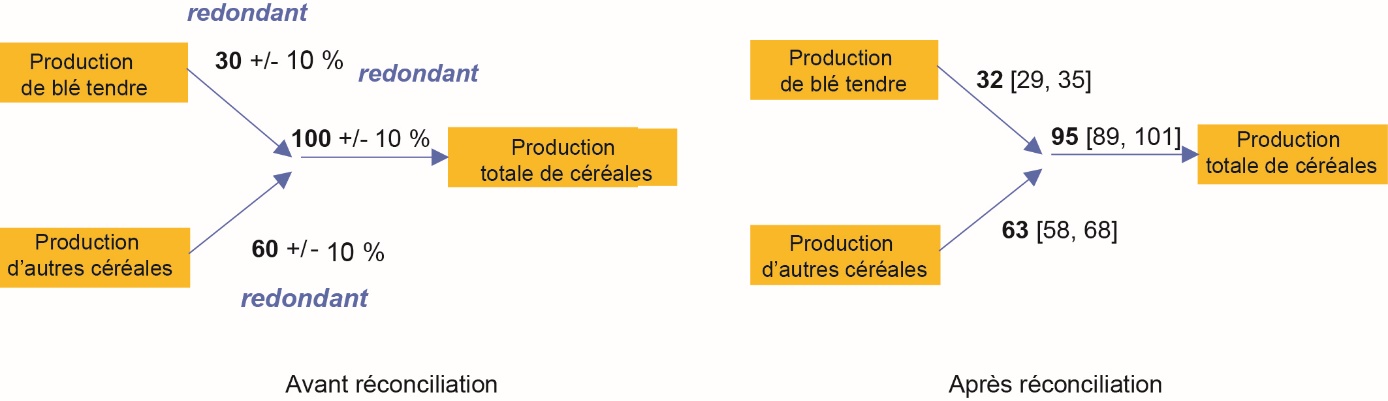
2) Détermination d’une inconnue
Dans ce cas, il n’existe pas de référence bibliographique ou source statistique pour un des flux, ici le flux « production d’autres céréales ». Ce dernier est cependant déterminable de façon unique grâce aux données disponibles pour les autres flux, grâce dans ce cas à la contrainte d’agrégation. Le modèle propose les valeurs centrales finales et intervalles de confiance pour chacun des flux.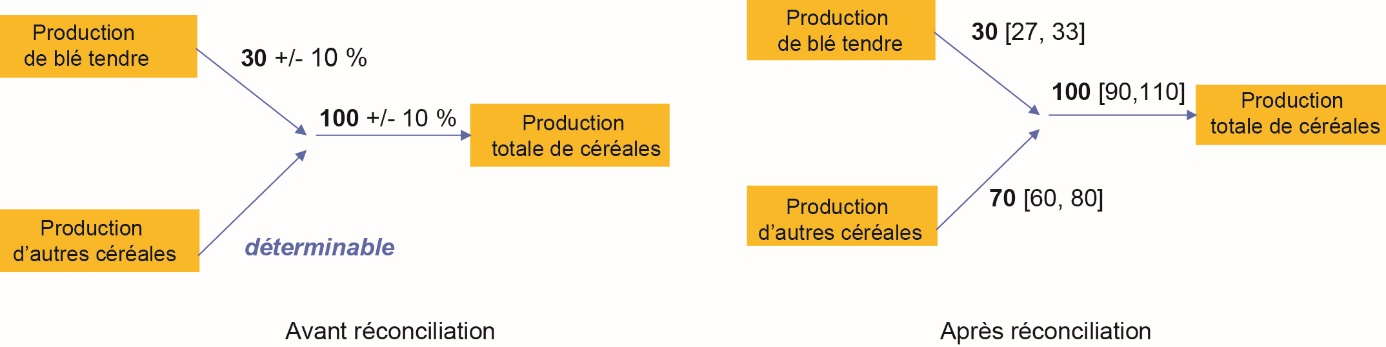
3) Estimation des intervalles pour des inconnues non-déterminables
Dans ce cas, il n’existe pas de référence bibliographique ou de source statistique ni pour le flux « production de blé tendre », ni pour le flux « production d’autres céréales ». Il n’y a par ailleurs pas suffisamment d’information pour déterminer ces flux de façon unique. Il est alors indispensable de se référer à l’intervalle de confiance pour estimer l’étendue possible pour ces flux.
Une fois les données d’entrée des différentes filières végétales et animales collectées, l’analyse des sources et les échanges avec les organismes producteurs des données ont permis d’associer à chaque donnée un coefficient d’incertitude (1, 5 ou 10 % ; cf. encadré 2) Ces coefficients permettent au modèle de calculer une valeur finale plus ou moins éloignée de la valeur d’entrée lors de la réconciliation.
Les données collectées sont ensuite organisées selon des tableaux emplois-ressources (TER), représentant les flux entrants et sortants à chaque maillon des filières. Les contraintes, qui expriment les relations entre ces flux, sont ensuite formulées sous forme d’égalités ou d’inégalités de combinaisons linéaires (cf. encadré 2).
À partir de ces TER et de ces contraintes, la réconciliation des données par optimisation sous contraintes a été effectuée au travers de la méthode et du logiciel AF Filières développés par l'INRIA (Courtonne et al., 2019).
b. Mise en œuvre pratique de la réconciliation
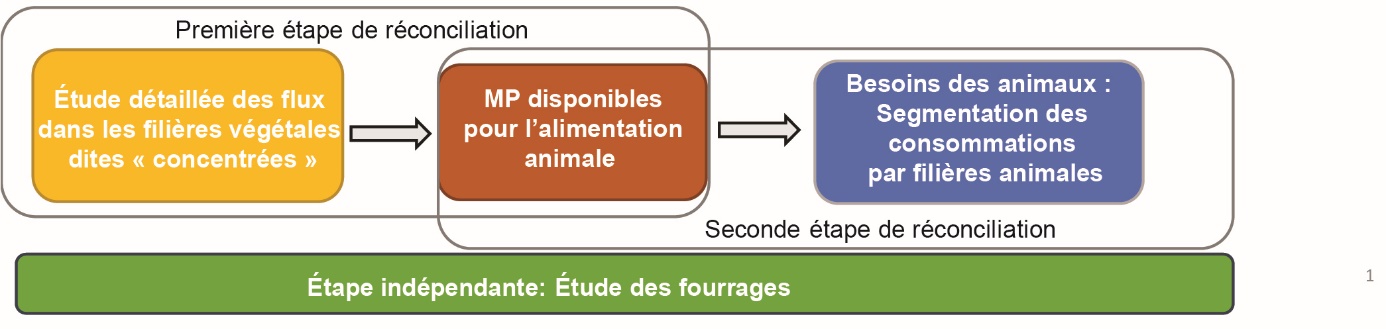
Le travail de réconciliation des données a été réalisé en trois étapes (figure 1). L’objectif de la première étape a été de quantifier les tonnages de chaque MP concentrée disponible pour l’alimentation animale. Cette étape de réconciliation a permis de quantifier les flux au sein des 17 filières végétales produisant des MP concentrées pour l’alimentation animale : production, import, export, maillons de transformation, génération de coproduits, utilisations finales.
La seconde étape de réconciliation a consisté à mettre en cohérence les disponibilités de MP pour l’alimentation animale au niveau national avec les besoins des différentes catégories d’élevages (cf. § 1.2.b). Cela a permis de segmenter les utilisations des MP étudiées pour chaque filière animale.
Enfin, l’étude des fourrages a fait l’objet d’une réconciliation à part entière, dissociée des MP concentrées, partant des ressources jusqu’aux consommations segmentées par filière animale.
Figure 1. Les trois étapes de réconciliations des données.
L’ensemble de ces trois étapes de réconciliations représente un total d’environ 5 000 flux et environ autant de contraintes. La grande majorité des contraintes servent à implémenter les agrégations (par ex, les céréales consommées par les bovins sont égales au blé tendre consommé par les bovins + le maïs consommé par les bovins +…). Les autres contraintes assurent les bilans matières au niveau de chaque produit (ce qui est utilisé est produit en France ou importé) et certaines relations entre les flux telles que des rendements de transformation.
On dénombre dans le détail, environ 800 flux pour l’étape 1, 3 800 pour l’étape 2 et 300 pour l’étape fourrages. L’étape 1 s’est déroulée sans encombre, en revanche, les étapes 2 et « fourrages » ont mis en évidence des « conflits » parmi les contraintes imposées au modèle. Pour surmonter cette difficulté, nous avons fait le choix d’assouplir les contraintes. En pratique, des termes pondérés représentant des biais (contraintes non respectées) ont été ajoutés aux équations de contraintes de la réconciliation des données. Nous avons en même temps ajouté aux contraintes du programme une fonction objectif de minimisation de ces termes et donc de l’erreur globale. Cela explique que pour les étapes 2 et « fourrages », certaines relations d’agrégation ne sont pas parfaitement respectées.
Dans les sections suivantes, nous tentons de distinguer ce qui, parmi les résultats, relève de limites de connaissances (imperfections des données émises par les sources d’informations) de ce qui relève de limites de modélisation rencontrées (imperfections de la modélisation des relations entre flux dans le système).
c. Unités utilisées dans la réconciliation des données et l’expression des résultats
Les flux des différentes matières doivent être comptabilisés dans une unité cohérente pour établir l’équilibre entre ressources et emplois aux différents nœuds du système. Les flux de fourrages et de matières concentrées ont été quantifiés en masse, mais dans une unité différente.
Les flux de fourrages ont été exprimés en tonnes de matière sèche (t MS), unité de référence pour ces matières premières. Toutefois, le tonnage en matière sèche n’étant pas une unité couramment utilisée par les professionnels du secteur des grains et de la nutrition animale pour quantifier les MP concentrées, les résultats pour les MP concentrées ont été exprimés en tonnage de matière sèche à 85 % (MS85). Ce taux de matière sèche correspond à celui des grains de céréales. Cette unité permet de s’affranchir des variations de taux d’humidité entre MP concentrées (coproduits principalement) pour ainsi comparer et sommer les volumes entre eux.
Cette expression différente des quantités des fourrages et des matières premières concentrées ne pose pas de problème dans la réconciliation des données puisqu’il n’y a pas eu de formulation de contrainte de substitution entre ces deux entités. Les rations des herbivores ont été établies à tonnage de fourrages et de concentrés donnés.
Les résultats de flux réconciliés, de même que les données d’entrée non réconciliées, ont été exprimées en t MS pour les fourrages et t MS85 pour les concentrés. Des conversions en protéines de ces différentes matières ont également été réalisées afin d’établir une cartographie des flux en équivalent protéines (cf. §5).
d. Représentation des résultats par les diagrammes de Sankey
Une fois les données réconciliées, les tableaux emplois-ressources ont été représentés sous la forme de diagrammes de Sankey (Courtonne et al., 2015). Un diagramme de Sankey est un type spécifique de diagramme permettant de représenter des flux de matières de façon synthétique et visuelle dans lequel la largeur d'un flux est proportionnelle à la quantité qu'il représente. Dans le cadre de notre étude, les diagrammes de Sankey ont été réalisés grâce à l'application en ligne développée par l'INRIA (https://www.flux-biomasse.fr/sankey-diagrams/) et sont consultables en ligne : https://www.flux-biomasse.fr/alimentation_animale.
2. Les flux de matières premières concentrées
2.1. Production et principales utilisations de matières premières concentrées
Après réconciliation des données, le gisement en MP concentrées pour 2015 - défini comme la somme de la production nationale et des importations – a été estimé entre 95,5 et 97 Mt MS85. Comme l’illustre la figure 2, une large partie des MP étaient exportées (44 à 47,5 Mt MS85), principalement sous forme de grains de céréales, mais aussi de coproduits. Parmi les 49,5 à 52,5 Mt MS85 utilisées sur le marché intérieur, environ 34 Mt MS85 étaient consommées par les animaux d’élevage (figure 2). Le restant se répartissait entre l’alimentation humaine (5,2 à 5,8 Mt MS85, cette valeur n’incluant pas le sucre, le riz, les fruits et légumes, et les produits animaux…) et les autres utilisations (10,3 à 11,6 Mt MS85) qui regroupent la production de semences, d’alcool, de « petfood », d’énergie, de fertilisants ainsi que les pertes.
Du fait de la seconde réconciliation consommation par les animaux, l’intervalle min/max entourant le flux vers l’alimentation animale est plus faible que ceux estimés pour les autres types d’utilisation appliquée au maillon représentant les flux de.
Figure 2. Production, imports, exports et utilisation de matières premières agricoles (hors fourrages) en 2015 en France (en Mt MS85).

* Luzerne déshydratée uniquement (la luzerne non déshydratée est incluse dans les fourrages) ; betterave remplacée par ses coproduits utilisés en alimentation animale.
CP : Coproduits ; DE : Direct élevage (matières premières achetées par les éleveurs en l’état brut) ; FAB : Fabricants d’aliment du bétail ; IC : intra consommation (matières premières produites à la ferme et consommées par les animaux) ; MP : matières premières.
Parmi les 34 Mt MS85 consommées par les animaux, 62 % étaient transformées par l’industrie de la fabrication d’aliments du bétail (FAB) et 38 % étaient utilisées directement à la ferme pour la FAF (fabrication d’aliments à la ferme). Les MP utilisées en FAF sont la réunion de deux catégories : les MP intra-consommées (IC), produites à la ferme pour la consommation des animaux (23 %), il s’agit principalement de céréales sous forme de grains, et les MP utilisées en « direct élevage » (DE), achetées pour être consommées à la ferme (15 %), qui sont notamment les tourteaux et coproduits de l’industrie agroalimentaire. Les MP consommées par les animaux d’élevage appartenaient à trois catégories principales : les céréales sous forme de grains (56 %), les tourteaux (23 %) et les coproduits céréaliers (9 % : sons, drèches…), les deux pourcents restants correspondent aux autres matières premières tels les coproduits, les minéraux ou encore les vitamines.
Les ordres de grandeur des résultats obtenus sont cohérents avec les estimations d’autres études récentes. En effet, dans ses travaux qui se rapportaient à l’année 2010, Dronne (2018) évaluait la consommation française et les consommations de MP concentrées par les animaux d’élevage à 32,7 Mt de matière brute. En moyenne annuelle pour la période 2007-2009, Agreste (2013) évaluait les besoins de l’alimentation animale française à 39,7 Mt de matière brute.
2.2. Segmentation des consommations de matières premières concentrées par filières animales
En 2015, comme le montre le tableau 1, les bovins (laitiers, mixtes et à viande) étaient les premiers consommateurs de MP concentrées (37 % des utilisations animales), suivis par les filières avicoles (34 % pour la somme des volailles de chair, de ponte et des palmipèdes gras) et par les porcins (23 %). Les deux premières filières consommatrices de céréales étaient les volailles et les porcs. Les bovins laitiers et mixtes étaient les premiers consommateurs de coproduits céréaliers (49 %), suivis par les porcs (21 %). Les tourteaux étaient utilisés en premier lieu par les bovins laitiers et mixtes et par les volailles.
Tableau 1. Estimations des consommations de matières premières concentrées par filières animales en France en 2015 (en × 1 000 t de MS85).
Tous |
Bovins |
Bovins |
Porcs |
Volailles |
Volailles |
Palmipèdes |
Caprins |
Ovins |
Ovins |
Equins |
Lapins |
|
|---|---|---|---|---|---|---|---|---|---|---|---|---|
Total matières |
34 037 |
8 446 |
4 019 |
7 767 |
6 090 |
3 255 |
2 100 |
404 |
282 |
521 |
309 |
399 |
Grains |
19 637 |
3 067 |
2 213 |
5 583 |
4 039 |
2 127 |
1 752 |
251 |
178 |
353 |
NC |
65 |
Céréales |
18 903 |
2 845 |
2 115 |
5 512 |
3 895 |
2 106 |
1 571 |
251 |
178 |
353 |
NC |
63 |
Dont blé tendre |
7 780 |
1 176* |
897* |
1 688 |
2 191* |
1 128* |
553* |
30* |
31* |
56* |
NC |
24* |
Dont maïs grain |
6 786 |
704* |
675* |
2 464 |
1 026* |
739* |
963 |
57* |
53* |
93* |
NC |
9* |
Dont orge |
1 917 |
289* |
245* |
798 |
119* |
117* |
28* |
102* |
58* |
148* |
NC |
9* |
Oléoprotéagineux |
735 |
224 |
99 |
72 |
143 |
20* |
183 |
0* |
1* |
1* |
NC |
1 |
Coproduits |
13 693 |
5 142 |
1 724 |
1 994 |
1 945 |
1 034 |
346 |
156 |
103 |
158 |
NC |
334 |
Céréaliers |
3 000 |
1 470* |
440* |
646 |
155 |
104 |
25 |
44* |
11* |
34* |
NC |
57 |
Tourteaux |
7 823 |
2 603 |
773 |
1 152 |
1 459 |
780 |
243 |
15 |
33 |
56* |
NC |
101 |
Dont tourteau |
3 824 |
1 367 |
290 |
224 |
1 127 |
425 |
103* |
1 |
20* |
8* |
NC |
0 |
Huiles végétales |
112* |
0* |
0* |
6* |
92* |
18* |
0* |
0* |
0* |
0* |
NC |
0* |
Luzerne |
576 |
219 |
125 |
0 |
0 |
0 |
0 |
44 |
41 |
11* |
NC |
77* |
Pulpes de |
900 |
488* |
233* |
8* |
6* |
5* |
1* |
27* |
5* |
38* |
NC |
81* |
Autres coproduits |
1 286 |
365* |
153* |
179* |
232* |
124* |
77* |
26* |
16* |
22* |
NC |
16* |
Aliments |
708* |
236* |
81* |
187 |
106* |
95* |
2* |
0* |
1 |
10* |
NC |
1 |
Résultats issus de la réconciliation des données avec la méthode d’optimisation sous contraintes (valeur centrale). Afin de rendre le problème soluble, certaines contraintes ont été légèrement assouplies : par exemple, en toute rigueur « Tous animaux d’élevage » devrait être égal à la somme de « Bovins laitiers & mixtes » + « Bovins à viande » + …, alors que le tableau montre un écart d’un peu plus de 1 % entre les deux. L’écart constaté est plus important pour d’autres catégories comme les tourteaux (5 %).
(*) Les valeurs affectées d’un astérisque présentent un écart entre la valeur minimale et la valeur maximale de l’intervalle donné par le modèle supérieur à 20 % et doivent être interprétées avec prudence.
L’analyse détaillée des résultats a permis de mettre en lumière un besoin d’approfondissement des connaissances sur les utilisations de MP concentrées dans les rations des herbivores. En effet, les données d’entrée sur les consommations des monogastriques sont assez détaillées par MP, permettant d’aboutir à une segmentation fine des MP concentrées consommées A l’inverse, les données d’entrée disponibles pour décrire les consommations de MP concentrées par les ruminants ne précisent pas les utilisations par sous-catégories de MP. Par exemple, le volume de céréales dans les rations des bovins est connu de façon globale sans précision sur la répartition entre le blé, le maïs, l’orge, et les autres céréales. Ainsi, les données d’entrée étant peu contraintes pour les rations des herbivores, le modèle de réconciliation a pu s’en servir comme variable d’ajustement. Cela s’est traduit par de larges intervalles min/max pour certaines sous-catégories de MP concentrées consommées par les herbivores. A titre d’exemple, l’intervalle min/max pour le blé consommé par les bovins laitiers et mixtes est de 3 kt à 1 800 kt MS85 et celui de l’orge entre 164 et 813 kt MS85. Ainsi, les résultats des utilisations de blé par les bovins laitiers et mixtes sous forme de valeur centrale (tableau 1) semblent surestimés par rapport aux autres céréales, notamment l’orge (dont par ailleurs les disponibilités globales pour l’alimentation animale pourraient être sous-estimées).
Pour pallier ce problème, il serait nécessaire de disposer d’un niveau de détail et d’une nomenclature semblable sur les consommations de chaque sous-catégorie de MP concentrées pour toutes les filières animales. De plus, les références utilisées pour la description de l’alimentation des herbivores (cf. § 1.2.b) sont parfois assez anciennes et mériteraient une actualisation (progrès technique, changement des systèmes…). On sait par ailleurs que les consommations ne sont pas figées puisque certaines MP sont substituables entre elles en fonction des prix et des disponibilités annuelles. Ces substitutions sont prises en compte pour le segment FAB via les données du modèle « Prospective Aliment » du CEREOPA. Pour le segment IC et DE, elles sont prises en compte de manière différenciée entre filières. Par exemple, les rations formulées en FAF porc mettent en évidence ces substitutions, qui restent toutefois plus faibles par rapport au segment FAB en raison d’un nombre plus restreint de matières premières utilisées en FAF, consécutif aux contraintes d’équipements et au nombre limité de silos. En herbivores la composition précise de certaines catégories comme les céréales n’est pas spécifiée pour les consommations en IC et DE.
3. Les flux de fourrages
3.1. Production et grandes utilisations de fourrages
Pour l’année 2015, la réconciliation des données a permis d’estimer la production française de fourrages (hors paille) entre 80,5 et 87,8 Mt MS (figure 3), et celle de paille entre 17,0 et 18,8 Mt MS. La majorité de la paille est utilisée en litière. Les tonnages de fourrages consommés par les herbivores ont été estimés entre 70,0 et 72,5 Mt MS, soit entre 82 et 87 % de la production. Les fourrages non consommés par les animaux correspondent aux pertes de stockage (4 à 9 Mt MS) aux refus de distribution (0,5 à 5,5 Mt MS), au refus de pâturage (2 à 4 Mt MS) c’est-à-dire les non-prélèvements par les animaux pâturant, et enfin les surfaces non exploitées (environ 2,5 Mt MS).
La consommation fourragère totale par les herbivores (figure 3) était segmentée comme suit : 46 % d’herbe pâturée (30,5 à 33,7 Mt MS), 32 % d’herbe conservée (21,8 à 24 Mt MS), 21 % d’ensilage de maïs (14,9 Mt MS) et 1 % d’autres fourrages (1,8 à 2,2 Mt MS).
Figure 3. Nature des fourrages consommés par le cheptel français en 2015 (en Mt MS), données réconciliées.
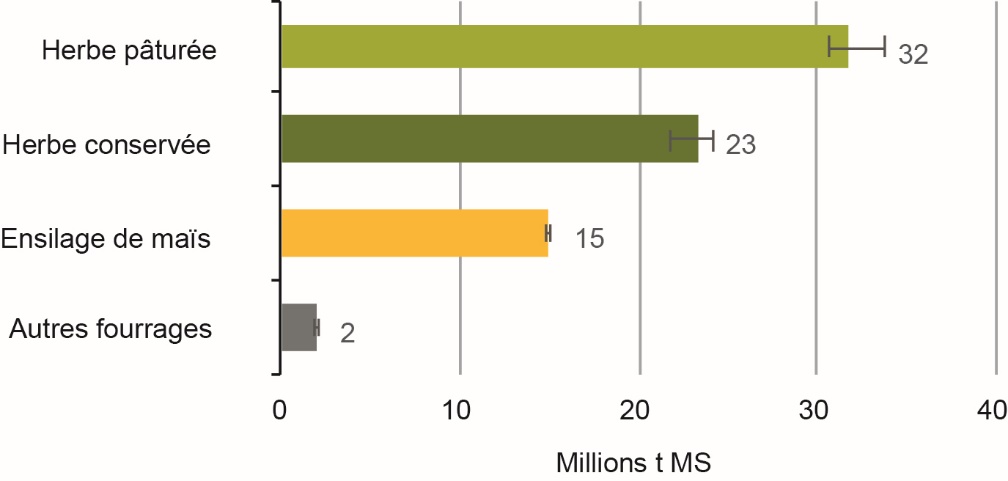
Les barres d’erreur représentent l’intervalle min/max du flux donné par la réconciliation des données.
Les ordres de grandeur des résultats obtenus sont cohérents avec les estimations d’autres études récentes sur l’ensemble de la France, Outre-Mer inclus. En effet, dans ses travaux qui se rapportaient à l’année 2010, Dronne (2018) évaluait la consommation française de fourrage à 72 Mt MS. De son côté, Agreste (2013) évaluait la consommation annuelle moyenne de fourrages pour l’alimentation des animaux en France à 67,9 Mt MS pour la période 2007-2009.
3.2. Répartition des consommations de fourrages entre filières herbivores
Les bovins étaient de loin les premiers utilisateurs de fourrages en France en 2015 avec 89 % des consommations fourragères (tableau 2). L’ensilage de maïs était consommé à 80 % par les bovins laitiers et mixtes, représentant 36 % de leur consommation de fourrages. Les bovins à viande consommaient 18 % de l’ensilage de maïs et 49 % de l’herbe pâturée ou conservée, des deux types représentant 61 % de leurs consommations de fourrages. Les deuxièmes consommateurs de fourrages étaient les équins, avec 5 % des volumes totaux.
Tableau 2. Estimations des consommations de fourrages selon les filières herbivores en France, en 2015 (données exprimées en x1 000 t de Matière Sèche - MS).
Tous |
Bovins |
Bovins |
Caprins |
Ovins |
Ovins |
Equins |
|
|---|---|---|---|---|---|---|---|
Total Fourrages |
71 785 |
33 275 |
30 411 |
695 |
997 |
2 791 |
3 540* |
Ensilage de maïs |
14 901 |
11 963 |
2 643 |
28 |
23 |
27 |
0 |
Herbe conservée |
23 388 |
9 068 |
10 518 |
537 |
412 |
650 |
2 233* |
Herbe pâturée |
31 726 |
11 389 |
16 468 |
116 |
533 |
2 039 |
1 209* |
Autres fourrages |
1 845* |
847 |
777 |
9 |
25 |
71 |
94* |
Résultats issus de la réconciliation des données avec la méthode d’optimisation sous contraintes (valeur centrale). Compte tenu de l’assouplissement des contraintes, certains résultats agrégés présentés dans ce tableau ne sont pas égaux à la somme de leurs composantes (exemple : « Tous animaux d’élevage » n’est pas égal à « Bovins laitiers & mixtes » + « Bovins à viande » + …).
(*) Les valeurs affectées d’un astérisque présentent un écart entre la valeur minimale et la valeur maximale de l’intervalle donné par le modèle supérieur à 20 % et doivent être interprétées avec prudence.
En ce qui concerne la quantification des consommations par les équins, le manque de références statistiques et bibliographiques pour cette filière (cf. § 1.2.b) a conduit à un grand nombre d’inconnues non-déterminables en entrée de la réconciliation. Ainsi, les résultats sous forme de valeur centrale tels que présentés dans le tableau 2, se révèlent fragiles pour cette filière. L’analyse des résultats sous forme d’intervalle min/max permet de le traduire. Elle montre notamment que la fourchette des consommations estimées par réconciliation est large : entre 2,1 et 3,9 Mt MS de fourrages étaient consommées par les chevaux en France en 2015, incluant 0,7 à 2,7 Mt MS d’herbe conservée et 0,1 à 3,0 Mt MS d’herbe pâturée. Les valeurs basses de ces fourchettes, totalement improbables, s’expliquent principalement par les forts coefficients d’incertitude associés à cette filière.
4. Le « feed system » français
Le diagramme de Sankey ci-dessous (figure 4) permet de synthétiser l’ensemble des résultats détaillés dans les paragraphes précédents pour décrire la cartographie des flux dans le « feed system » français : de la production à la segmentation des utilisations de MP par les filières animales.
Cette représentation visuelle des flux met en évidence l’importance de l’export comme débouché de la production française de MP (37,2 Mt MS85 de grains 2015, dont 18,8 Mt MS85 de blé tendre). Comparativement aux exportations et à la production nationale, les importations de MP apparaissent relativement faibles. Les coproduits importés sont très majoritairement des tourteaux, tandis que les coproduits exportés sont essentiellement des coproduits céréaliers. Par ailleurs, l’importance des coproduits dans l’alimentation animale souligne l’interdépendance entre l’alimentation animale et d’autres secteurs consommateurs de produits et coproduits végétaux, en particulier l’alimentation humaine et la production d’agrocarburants.
Enfin, la représentation sous forme de diagramme de Sankey permet également de mettre en exergue l’importance des fourrages (exprimés en matière sèche) dans l’alimentation des herbivores, et en particulier des filières bovines.
Figure 4. Diagramme de Sankey représentant les flux de matières premières en alimentation animale en France en 2015.

Les flux de fourrages sont exprimés en t de MS et les flux de matières premières concentrées en t de MS85, unités couramment utilisées par les professionnels de l’alimentation (cf. § 1.3.c.)
5. Les protéines
5.1. Disponibilités en protéines et segmentation de leur consommation par les animaux
L'indicateur matières azotées totales (MAT) a été choisi pour quantifier les flux de protéines. Pour chaque MP, les teneurs en MAT ont été estimées à partir des valeurs proposées dans les Tables INRA (2018), complétées par les travaux de Graux et al. (2017) pour les fourrages. Ainsi, les teneurs en protéines retenues pour effectuer les calculs, qui dans les faits peuvent varier d'une année à l'autre en fonction des conditions pédoclimatiques, ne sont donc pas spécifiques de l'année étudiée. Ces teneurs en MAT ont été appliquées aux données réconciliées en MS85 pour les MP concentrées et en MS pour les fourrages.
Pour l’année 2015, la consommation totale de protéines (fourrages inclus) par l’élevage français a été évaluée à environ 15 Mt de MAT, dont 9,3 Mt provenant des fourrages (tableau 3). Parmi les 5,9 Mt de MAT provenant des MP concentrées, les filières bovines étaient les premières consommatrices en 2015 avec environ 1,7 Mt de MAT pour les bovins laitiers et mixtes et 0,65 Mt de MAT pour les bovins à viande. Les deuxièmes utilisateurs de protéines issues des MP concentrées étaient les filières volailles (1,9 Mt de MAT pour la somme des volailles de chair, volailles de ponte et palmipèdes gras), suivies des porcs (1,1 Mt de MAT).
En comparaison, les consommations de protéines pour l’alimentation animale en France étaient évaluées par Dronne (2018) pour l’année 2010 à 12,3 Mt MAT dont 6,2 Mt MAT provenant des fourrages, mais avec un taux de 8 % de MAT/MS sur l’ensemble de la production de la STH (surface toujours en herbe). Dans une autre étude, Huyghe (2003) estimait la production de protéines de fourrages en France à 8,4 Mt MAT. Les écarts entre ces différentes estimations proviennent des évolutions des surfaces de certains types de fourrages et de différences dans les taux protéiques moyens retenus. Dans notre étude, nous avons estimé les taux de protéines de 4 grandes catégories de fourrages (ensilage de maïs 8 % de MAT/MS ; herbe conservée 12 % de MAT/MS ; herbe pâturée 15,9 % de MAT/MS ; autres fourrages 16 % MAT/MS). Par besoin de simplification, pour chaque catégorie de fourrages une même teneur en MAT a été appliquée quelle que soit l’espèce d’herbivores qui la consomme. Une piste d’amélioration de ces résultats serait de pouvoir quantifier plus précisément les taux protéiques selon les types de fourrages et les catégories d’animaux auxquelles ils sont destinés (en particulier pour l’herbe pâturée selon qu’elle l’est par des animaux laitiers ou non).
Tableau 3. Estimations des consommations de protéines issues des matières premières concentrées et des fourrages par les filières animales en France, en 2015 (données exprimées en × 1 000 t Matières Azotées Totales - MAT).
Tous animaux d'élevage |
Bovins laitiers |
Bovins à |
Porcs |
Volailles |
Volailles |
Palmipèdes |
Caprins |
Ovins |
Ovins |
Equins |
Lapins |
|
|---|---|---|---|---|---|---|---|---|---|---|---|---|
Total matières |
5 773 |
1 714* |
648* |
1 057 |
1 062* |
537* |
283* |
51* |
42* |
67* |
92 |
71* |
Grains |
1 918 |
321* |
220* |
511 |
408 |
203* |
176* |
23* |
17* |
33* |
NC |
7* |
Céréales |
1 757 |
272* |
199* |
495 |
377 |
199* |
136* |
23* |
16* |
33* |
NC |
6* |
Dont blé tendre |
829 |
125* |
96* |
180 |
234 |
120* |
59* |
3* |
3* |
6* |
NC |
3* |
Dont maïs grain |
508 |
53* |
51* |
184 |
77* |
55* |
72 |
4* |
4* |
7* |
NC |
1* |
Dont orge |
183 |
28* |
23* |
76 |
11* |
11* |
3* |
10* |
6* |
14* |
NC |
1* |
Oléoprotéagineux |
161* |
49* |
22* |
16* |
31* |
5 |
40* |
0* |
0* |
0* |
NC |
0* |
Coproduits |
3 855 |
1 392* |
427* |
547 |
654 |
333 |
106* |
27* |
25* |
34* |
NC |
64 |
Céréaliers |
577 |
283* |
85* |
124 |
30 |
20 |
5 |
8 |
2* |
7* |
NC |
11 |
Tourteaux |
2 871 |
971 |
275 |
386 |
579 |
289 |
87* |
5* |
12* |
18* |
NC |
31 |
Dont tourteau |
1 615 |
577 |
123 |
95 |
476 |
179 |
43* |
0* |
9 |
4* |
NC |
0 |
Huiles végétales |
0 |
0 |
0 |
0 |
0 |
0 |
0 |
0 |
0 |
0 |
NC |
0 |
Luzerne |
98 |
37 |
21 |
0 |
0 |
0 |
0 |
7 |
7 |
2 |
NC |
13 |
Pulpes |
69 |
37* |
18* |
1* |
0 |
0 |
0 |
2* |
0* |
3* |
NC |
6 |
Autres coproduits |
241 |
64* |
28* |
36 |
45* |
24* |
15* |
5* |
3* |
4* |
NC |
3* |
Total Fourrages |
9 324 |
3 990 |
4 216 |
|
|
|
|
86 |
139 |
415 |
475* |
|
Ensilage de maïs |
1 192 |
957 |
211 |
|
|
|
|
2 |
2 |
2 |
0* |
|
Herbe conservée |
2 807 |
1 088* |
1 262 |
|
|
|
|
64 |
49 |
78 |
268* |
|
Herbe pâturée |
5 044 |
1 811 |
2 618 |
|
|
|
|
18 |
85 |
324 |
192* |
|
Autres fourrages |
281* |
134* |
124* |
|
|
|
|
1* |
3* |
11* |
14* |
|
TOTAL |
15 097 |
5 704 |
4 863* |
1 057 |
1 062* |
537* |
283* |
137* |
181* |
481* |
566* |
71* |
Résultats issus de la conversion en protéines des résultats sous forme de valeur centrale (source des taux protéiques des matières premières : Tables INRA (2018) ; Graux et al., 2017). Compte tenu de l'assouplissement des contraintes, certains résultats agrégés présentés dans ce tableau ne sont pas égaux à la somme de leurs composantes (exemple : « Tous animaux d'élevage » n'est pas égal à « Bovins laitiers & mixtes » + « Bovins à viande » + …).
(*) Les valeurs affectées d’un astérisque présentent un écart entre la valeur minimale et la valeur maximale de l’intervalle donné par le modèle supérieur à 20 % et doivent être interprétées avec prudence.
5.2. Le cas du soja
Environ 3,8 Mt MS85 de tourteau de soja étaient consommées en 2015, et ce tourteau représentait 49 % du total des tourteaux consommés en France (tableau 1). Les 51 % restants étant majoritairement composés de tourteau de colza et de tourteau de tournesol. Mais, compte tenu d’une teneur en MAT supérieure à celle des autres tourteaux, le tourteau de soja représentait à lui seul 56 % des protéines issues de tourteaux consommées en France (tableau 3). Le soja représentait aussi 28 % des protéines issues de MP concentrées consommées par les animaux d’élevage en 2015 (tableau 3). Mais en incluant les protéines issues des fourrages, le tourteau de soja ne représentait plus que 11 % des protéines consommées par les animaux d’élevage.
La figure 5 représente les flux de soja dans le « feed system » français sous forme de diagramme de Sankey. Les bovins laitiers et mixtes étaient les premiers utilisateurs de tourteau de soja avec 36 % du tonnage total suivis par les volailles de chair (29 %), les volailles de ponte (11 %), les bovins à viande (8 %) et les porcins (6 %). Les importations de graines de soja, ensuite transformées en France, représentent une faible part de l’approvisionnement en tourteau de l’élevage français et la production française de soja utilisée par l’industrie de la trituration est quasiment nulle (le soja français est plutôt utilisé en alimentation humaine ou en graine entière en alimentation animale). La France est donc fortement dépendante des importations directes de tourteaux de soja, qui représentaient 90 % du total de l’approvisionnement en 2015. La dépendance française aux importations de soja (graines et tourteaux cumulés) pour l’alimentation des animaux d’élevage est donc estimée quant à elle entre 95 et 100 %.
Figure 5. Diagramme de Sankey représentant les flux de consommation par les animaux et les autres utilisations du soja en 2015 (en 1000t de MS85)

Flux vert = flux de grains ; Flux orange =flux de tourteaux ; Flux bleu = flux d’huile
À noter que l’année sur laquelle porte l’étude (2015) correspond à l’une des années de la décennie 2010-2020 pour laquelle les importations françaises de soja (graines et tourteaux combinés) ont été parmi les plus élevées. Cela s’explique par le prix relatif du soja par rapport aux autres matières premières, ainsi que par la suppression des quotas laitiers au niveau de l’Union Européenne. Celle-ci a constitué une opportunité pour les éleveurs laitiers d’augmenter leur production, ce qui a entraîné de fortes importations de tourteau de soja en 2015.
5.3. La forte dépendance française aux importations de matières premières riches en protéines
Les résultats issus de la réconciliation des données montrent que la balance commerciale française en 2015 était globalement nettement excédentaire en protéines végétales grâce aux 4,4 Mt de MAT exportées, majoritairement sous forme de céréales. Les protéines importées, environ 2,7 Mt MAT, l’ont été principalement sous forme de tourteaux (75 %).
En identifiant l’origine (nationale ou importée) des MP utilisées en alimentation animale, les résultats ont permis d’estimer l’autonomie protéique de l’élevage français, définie par la Direction Générale Agriculture de la Commission européenne (2019) dans les bilans d’approvisionnement de l’alimentation animale en UE, comme le rapport entre les protéines d’origine nationale consommées en alimentation animale et les consommations totales de protéines par l’élevage français :
Hors fourrages et hors aliments minéraux et vitaminiques, l’autonomie protéique de l’élevage français était de l’ordre de 59 % en 2015. En tenant compte des fourrages, le taux d’autonomie atteignait 84 % (tableau 4).
Plus précisément, cette autonomie protéique peut être calculée en distinguant trois catégories de MP : les fourrages, les céréales et les Matières Riches en Protéines (MRP), définies comme les MP contenant plus de 15 % de protéines (Terres Univia, 2017). Elles regroupent les tourteaux, les graines oléagineuses et protéagineuses, certains coproduits céréaliers et la luzerne déshydratée. L’autonomie de l’élevage français en protéines issues des fourrages et des céréales avoisinait ainsi les 100 %, tandis que le taux d’autosuffisance en protéines issues des MRP était seulement de 43 % en 2015. C’est donc principalement l’approvisionnement en MRP qui explique la dépendance de l’élevage français aux importations.
Figure 6. Estimation du taux d’autonomie protéique de l’élevage français en 2015 (en %).

L’autonomie protéique est définie comme le ratio entre le tonnage de protéines végétales originaires de France consommées par l’élevage et le tonnage total de protéines consommées par l’élevage français.
Pour réaliser ces calculs, il a été nécessaire d’estimer la part de protéines d’origine française pour chaque matière première utilisée pour l’alimentation animale. Ce travail a été particulièrement délicat pour les tourteaux. Les tourteaux peuvent en effet être importés, produits en France à partir de graines importées, ou être produits en France à partir de graines locales. Le résultat final peut varier en fonction des hypothèses retenues. Ainsi, afin de tenir compte de la complexité des échanges commerciaux, notamment transfrontaliers, nous avons considéré que les protéines de colza réimportées d’Allemagne et de Belgique sous forme de tourteau après y avoir été exportées sous forme de graines, sont d’origine française. Pour les tourteaux de tournesol, une distinction a été faite entre les tourteaux de tournesol HighPro (35 % de MAT), le plus souvent importés, et les tourteaux de tournesol standards (28-30 % de MAT) majoritairement d’origine française. Pour les autres matières premières, par souci de simplification et en cohérence avec la réalité des marchés, il a été considéré que la part des protéines importées à destination de l’alimentation animale était égale à la part des protéines importées pour toutes utilisations confondues (exemple : si 1 % du maïs français est importé, alors 1 % du maïs à destination de l’alimentation animale est importé).
Notre approche évalue l’autonomie protéique en MRP à 43 % contre 56 % en moyenne pour les deux campagnes agricoles 2014/15 et 2015/16 selon Terres Univia (2017). Mais le mode de calcul de notre étude diffère de celui de Terres Univia. En effet, la richesse des résultats obtenus dans notre étude, intégrant les flux d’import-export pour toutes les matières premières, nous a permis de répliquer le mode de calcul utilisé dans les bilans européens (DG Agri, 2019) à l’échelle de la France. Dans notre approche, le numérateur correspond aux protéines consommées en alimentation animale produites en France, tandis que les références françaises publiées jusqu’ici (Terres Univia, 2017) comparent la production totale française de MRP avec les protéines utilisées dans l’alimentation des cheptels français. Or, une partie de la production française de MRP n’est pas rendue disponible pour l’élevage français, car exportée ou utilisée pour d’autres débouchés comme l’alimentation humaine.
Par ailleurs, le regroupement des MRP réalisé dans cette étude est légèrement plus large que celui usuellement admis. En effet, l’ensemble de la catégorie des coproduits céréaliers a été considéré comme MRP puisque la teneur protéique moyenne pondérée de cette catégorie de MP a été évaluée à 19 %. Il s’agit donc d’un niveau supérieur au taux de 15 % de protéine retenu par la définition des MRP. Cependant, quelques coproduits céréaliers intégrés à cette catégorie (principalement les farines basses) présentent en réalité un taux protéique inférieur à 15 %. De plus, seules les drèches de céréales sont considérées comme MRP dans les références de Terres Univia (2017). Cette nuance sur les coproduits céréaliers inclus dans les MRP a toutefois une faible incidence sur le résultat du calcul de l’autonomie protéique. C’est bien le choix d’un numérateur, spécifique aux consommations de l’élevage français selon la définition que nous avons retenue, qui explique la différence d’ordre de grandeur entre les deux modes de calcul.
6. Des perspectives d’amélioration de la méthode
6.1. Une méthode originale
A notre connaissance, cette étude est la première qui a cherché à mobiliser l’ensemble des données disponibles sur le « Feed System » français, depuis la production végétale jusqu’aux consommations par les animaux, et qui a impliqué l’ensemble des organismes producteurs de ces données afin de conduire leur analyse critique et leur mise en cohérence.
La méthode de réconciliation des données avec optimisation sous contraintes, déjà utilisée dans la filière forêt-bois, a permis la mise en cohérence de ces données en proposant des estimations des valeurs d’entrées manquantes et en donnant une valeur centrale de chacun des flux, encadrée par un intervalle de vraisemblance (min/max). Pour cela la méthode employée a nécessité d’estimer des coefficients d’incertitude autours des données d’entrée grâce à l’analyse détaillée des références et statistiques existantes pour décrire les filières. Cette étape a été conduite avec les organismes producteurs de ces données.
Enfin, l’utilisation de diagrammes de Sankey pour la représentation graphique des flux de MP en France présente une approche originale et permet d’appréhender les résultats de façon synthétique et visuelle, aussi bien pour un public initié que pour un public plus large.
6.2. Réconcilier les données en une seule étape pour améliorer la cohérence du jeu de données
Une piste d’amélioration globale de la méthode réside dans la réconciliation des données en une seule étape. En effet, comme explicité auparavant (figure 1), notre étude a réconcilié les données en plusieurs étapes : les données des filières végétales ont été réconciliées dans un premier temps afin d’aboutir aux volumes disponibles pour l’alimentation animale, puis ce poste de consommation a été mis en cohérence avec les consommations animales dans une seconde étape. Bien que les résultats obtenus soient satisfaisants, une réconciliation de l’ensemble des données en une seule étape aurait permis une cohérence plus approfondie du jeu de données dans son ensemble. Face à un volume de données très important, une réconciliation unique n’a pas pu aboutir à ce jour. En effet, la réconciliation en une seule étape exige de trouver la solution à un problème d’optimisation comportant plusieurs milliers de contraintes. L’ajout de contraintes augmente de manière exponentielle la probabilité de retenir des contraintes incompatibles entre elles. Dans la réconciliation actuelle en deux étapes, la détection des contraintes incompatibles a pris plusieurs dizaines de jours-hommes. Des travaux sont actuellement en cours à l’Inria pour progresser sur ces aspects. Cette réconciliation en deux étapes a eu pour conséquence de minimiser de façon sans doute trop importante l’intervalle min/max de consommation des MP concentrées.
De la même manière, les fourrages ont fait l’objet d’une réconciliation séparée. Toutefois, nous savons qu’une mauvaise récolte annuelle de fourrages peut être compensée par une hausse des consommations de matières premières concentrées par les ruminants. Une réconciliation unique des données permettrait alors aux volumes de fourrages disponibles pour l’année étudiée « d’influencer » les résultats des consommations des matières premières concentrées et vice-versa pour tenir compte des substitutions possibles. La formalisation de ces substitutions, mais aussi de celles entre MP concentrées, pourrait passer par des contraintes portant sur des aspects nutritionnels (besoins alimentaires des différentes catégories animales françaises, caractéristiques nutritionnelles des MP) et économiques (prix relatifs des différentes MP). Ce type de contraintes nutritionnelles et économiques a été formulé dans l’étude mais uniquement sur les monogastriques (porcs, volailles, lapins) et de manière séparée par espèce.
6.3. Adapter la périodicité aux campagnes agricoles plutôt qu’aux années civiles
Notre étude, à l’image de références antérieures, a donné des résultats appliqués à une année civile. Toutefois, les disponibilités et consommations de MP concentrées se raisonnent généralement par campagne agricole annuelle (une campagne débutant au moment des récoltes, et par convention pour les céréales de juillet à juin). Il s’agit d’une piste d’amélioration de la méthode qui permettrait une meilleure valorisation des données d’entrée exprimées selon cette périodicité (ex : bilan d’approvisionnement de FranceAgriMer), dans le but notamment de mieux prendre en compte les variations de stocks de matières premières au stade après récolte.
Les productions et disponibilités des différentes MP sont plus variables que les besoins alimentaires des cheptels, qui n’évoluent que lentement et par conséquent l’adoption de cette périodicité en campagne permettrait de gagner en précision. Cette possibilité est toutefois rendue difficile par le fait que l’enquête portant sur les utilisations de matières premières en fabrication industrielle d’aliments est effectuée sur une année civile.
6.4. Des données encore insuffisantes pour segmenter les flux de matières premières en agriculture biologique ou non OGM
La segmentation qualitative des flux de MP produites et utilisées en élevage biologique, et non-OGM faisait également partie des objectifs initiaux du travail. Toutefois, nous avons dû faire le constat que les données collectées pour ces filières différenciées étaient trop parcellaires et ne permettaient pas de construire les tableaux « emplois ressources » avec suffisamment de précision pour permettre une réconciliation des données.
Le manque de statistiques et de références sur ces MP produites dans des filières différenciées porte sur de nombreux maillons des filières. Pour l’offre, si la collecte de certaines MP produites en agriculture biologique (AB) fait l’objet d’un recensement, il n’existe pas de statistique française ni sur la production ni sur les importations de MP sous cahier des charges. En effet, les surfaces cultivées en agriculture biologique font l’objet d’un recensement, mais il n’existe pas d’estimations de rendement en agriculture biologique qui puisse être représentatif de l’ensemble de la production française. La production française de grains en AB n’étant pas estimée, évaluer les volumes utilisés en élevage est particulièrement difficile.
Parallèlement, les codes douaniers ne permettent pas de distinguer les critères de qualité (AB, sans-OGM) des MP importées ou exportées. Ainsi, les volumes de tourteaux biologiques et/ou garantis sans OGM disponibles sur le marché français ne sont pas connus avec précision. Pour l’année 2012, les importations françaises de graines de soja et de tourteau de soja non OGM étaient estimées à dire d’experts à environ 10 % du total (Tillie et Rodríguez-Cerezo, 2015), sans indication sur la dynamique d’évolution. En ce qui concerne les utilisations, certaines (FAB, meunerie) sont recensées par les services de l’Etat pour certains grains produits en AB (États 13, 8 et 8N, cf. §1.2.a). Les stocks de grains produits en AB sont également recensés (État 2). Pour les consommations par les animaux, incluant les volumes directement consommés à la ferme, le manque de références représentatives des rations utilisées en élevage biologique dans les différentes filières animales, qui varient très fortement selon les régions et les systèmes d’élevages, a rendu impossible le travail de segmentation des consommations par filières animales.
Conclusion
La méthode « flux de matières premières » a démontré sa capacité à réconcilier des données issues de sources multiples pour créer une vision partagée de la cartographie des flux de MP par les différents acteurs des filières françaises. Les résultats de l’étude ont permis de donner des repères collectifs aux filières sur les consommations des animaux d’élevage en France. Ils permettent notamment aux filières végétales d’avoir une connaissance plus détaillée de leurs débouchés, et aux filières animales de mieux appréhender les volumes nécessaires à leur approvisionnement. Par ailleurs, les résultats éclairent les questionnements sur l’alimentation des animaux d’élevage, en particulier sa durabilité, l’importance de l’élevage dans la valorisation des coproduits issus de l’agro-alimentaire ou encore l’autonomie alimentaire et protéique de l’élevage français.
Les travaux ont mis en avant un certain nombre de pistes d’amélioration de la méthode et ont permis de mettre en lumière des besoins de création ou de réactualisation de références (rations des herbivores, filières équines, distinction entre céréales, MP produites en AB et sans-OGM…).
Une pérennisation de l’observatoire des flux est à l’étude afin de disposer d’un suivi pluriannuel de l’évolution des consommations. Ce projet pourrait alors permettre de reproduire les estimations de flux de MP chaque année. Les pistes d’amélioration soulevée par la discussion de la méthode et des résultats de l’année 2015 pourront servir à perfectionner les futurs travaux autours de ce sujet qui présente des enjeux scientifiques, économiques, sociétaux, environnementaux et politiques.
Enfin, il serait pertinent de réaliser un exercice similaire à l'échelle des régions françaises (la preuve de concept ayant été apportée dans Courtonne et al., 2015). La plupart des données de récolte, de transport et de cheptel existent, d'autres devraient être estimées. Par exemple les flux liés aux industries de transformation pourraient l'être à partir des informations disponibles sur l'emploi dans ces secteurs. D'autres flux semblent plus délicats à traiter à l'échelle régionale comme la question des stocks de grains, notamment car ils peuvent soulever des questions de secret statistique. Des compromis seront à trouver : moyenner les flux sur plusieurs années permettrait de s'affranchir des variations de stock et d'augmenter globalement la fiabilité des bilans mais ferait perdre au passage la vision annuelle des évolutions.
Remerciements
Le projet a été réalisé, dans le cadre du GIS Avenir Élevages, avec le cofinancement d’INRAE, de FranceAgriMer, du CNIEL, de Terres Univia, d’INAPORC, de l’APCA, de l’IFIP, de l’Idèle et de l’ITAVI, avec la collaboration scientifique de l’INRIA (sur financement de l’Ademe, APR GRAINE) et la collaboration d’Agreste, de l’ANMF, d’AgroParisTech, d’Arvalis, du Céréopa, de la Coopération Agricole, du MAAF, de Réséda et du SNIA. Nous remercions également l’IFCE pour les informations fournies sur la filière équine.
Notes
- Les matières premières « concentrées » sont dénommées ainsi en opposition aux fourrages. Elles incluent l’ensemble des grains de céréales, les graines oléoprotéagineuses, les racines et tubercules, la luzerne déshydratée, les tourteaux et autres coproduits.
Références
- Agreste, 2011. Ministère de l’agriculture et de l’alimentation - agreste - La statistique, l’évaluation et la prospective agricole - Pratiques culturales sur les grandes cultures et prairies. http://agreste.agriculture.gouv.fr/enquetes/pratiques-culturales/pratiques-culturales-sur-les-918/ (consulté le 20/06/2019)
- Agreste, 2013. L’alimentation animale, principale destination des productions végétales. Synthèses Conjoncture n°3 Panorama, Moyens de production n° 2013/208, avril 2013, 16-24.
- Agreste, 2017. Les matières premières dans les aliments composés pour animaux de ferme en 2015. Agreste Primeur n° 345, juin 2017, 8p.
- Agreste, 2018. Une pousse d’herbe fortement déficitaire en 2018, Agreste Infos rapides, Prairies, octobre 2018, 3p.
- Berthelot N., Badouard B., 2011. Importance et diversité des aliments fabriqués à la ferme en élevages de porcs. TechniPorc, Vol. 34, N°1. https://www.ifip.asso.fr/sites/default/files/pdf-documentations/tp1badouard11.pdf (consulté le 15/06/2021)
- Boh M.Y., Clark O.G., 2020. Nitrogen and phosphorus flows in Ontario's food systems. Res. Conserv. Recycling, 154. doi:10.1016/j.resconrec.2019.104639
- Bonnin M., Azzaro-Pantel C., Pibouleau L., Domenech S., Villeneuve J., 2013. Development and validation of a dynamic material flow analysis model for French copper cycle. Chem. Engin. Res. Design. doi:10.1016/B978-0-444-59519-5.50025-3
- Bossis N., Legarto J., Lefrileux Y., Lazard K., Coursange H., Bluet B., Bealu C., Richard V., Lictevout V., Desbos V., Pommaret A., Blanchard F., Coutineau H., Ouin S., Morge F., 2012. Systèmes caprins d’alimentation respectueux de l’environnement.
- Bossis N., Jost J., Guinamard C., de Boissieu C., Boutin M., 2015. Accompagner le développement de l’autonomie alimentaire en élevage caprin laitier. IDELE, Collection Résultats 00 15 502 030, 36p.
- Cencic O., Rechberger H., 2008. Material Flow Analysis with Software STAN. J. Environ. Engin. Manag., 18, 5.
- Cordier, 2019. Flux de matières premières au sein du système « alimentation des animaux de rente », France, 2015 Établissement et application d’une méthodologie. Rapport détaillé Première partie du projet GIS Avenir élevages. 82p. https://www.gis-avenir-elevages.org/content/download/3602/35221/version/1/file/Rapport+FMP+-+GIS+Avenir+Elevage_v1.6.pdf
- Courtonne J.Y., Alapetite J., Longaretti P.Y., Dupré D., Prados E., 2015. Downscaling material flow analysis: the case of the cereal supply chain. Ecol. Econo., 188, 67-80. doi:10.1016/j.ecolecon.2015.07.007
- Courtonne J.Y., Alapetite J., Bevione M., Caurla S., Wawrzyniak V., Ravaud Y, 2019. AF Filières – Analyse des Flux des Filières biomasse pour des stratégies régionales de bioéconomie. Rapport final.
- Devun J., Legarto J., 2011. Fourrages conservés et modes de récolte : la situation selon les systèmes d’élevage en France. Fourrages, 206, 91-105.
- Devun J., Brunschwig P., Guinot C., 2012. Alimentation des bovins : rations moyennes et niveaux d’autonomie alimentaire. IDELE, Collection Résultats, Compte rendu résultats 00 12 39 005, décembre 2013, 45p.
- DG Agri, 2019. EU feed protein balance sheet. En ligne : https://ec.europa.eu/info/food-farming-fisheries/farming/facts-and-figures/markets/overviews/balance-sheets-sector/oilseeds-and-protein-crops_en (consulté le 07/05/2020).
- Dronne Y., 2018. Les matières premières agricoles pour l’alimentation humaine et animale : l’UE et la France. In : Ressources alimentaires pour les animaux d’élevage. Baumont R. (Ed). Dossier, INRA Prod. Anim., 31, 181-200. doi:10.20870/productions-animales.2018.31.3.2347
- Duc G., Anton M., Baranger A., Biarnes V., Buitink J., Carrouée B., Georget M., Jeuffroy M.-H., Lessire M., Magrini M.B., Pinochet X., Walrand S., 2015. Pertes alimentaires dans la filière protéagineuse, INRA, Innov. Agron., 48, 127-141.
- Dulphy J.P., 1987. Fenaison : pertes en cours de récolte et de conservation. In : Demarquilly C. (Ed). Les Fourrages secs : récolte, traitement, utilisation. INRA, Paris, France, 103-124.
- Dulphy J.P., Martin-Rosset W., 2001. Valeurs comparatives de différents types de Fourrages conserves. In : Garel J.P., Josien E. (coord.) Étude de la faisabilité de la mise en œuvre de l’arrêt de l’utilisation des fourrages fermentés. Pôle fromager AOC Massif Central, Aurillac, France, 12-30.
- États 2, 2015. Suivi mensuel de la collecte et des stocks, FranceAgriMer.
- États 8, 2015. Suivi mensuel de l’activité de la meunerie, FranceAgriMer.
- États 13, 2015. Suivi mensuel de l’activité des fabricants du bétail, FranceAgriMer.
- FACCO, 2016. Données économiques 2016 basé sur les données des adhérents FACCO.
- Fine F., Lucas J.L., Chardigny J.M., Redlingshöfer B., Renard M., 2015. Pertes alimentaires dans la filière oléagineuse, INRA, Innov. Agron., 48, 97-114.
- FranceAgriMer, 2018. Conjoncture marché des céréales, Statistiques mars 2018.
- Graux A.I., Delaby L., Peyraud J.L., Casellas E., Faverdin P., Le Bas C., Meillet A., Poméon T., Raynal H., Resmond R., Ripoche D., Ruget F., Therond O., Vertès F., 2017. Les prairies françaises : production, exportation d’azote et risques de lessivage. Rapport d’étude, INRA France, 74p.
- Hache E., 2015. Géopolitique des protéines. Revue internationale et stratégique, 1, 36-46. doi:10.3917/ris.097.0036
- Herrero M., Havlík P., Valin H., Notenbaert A., Rufino M.C., Thornton P.K., Blümmel M., Weiss F., Grace D., Obersteiner M., 2013. Biomass use, production, feed efficiencies, and greenhouse gas emissions from global livestock systems, PNAS, 110, 20888-20893. www.pnas.org/cgi/doi/10.1073/pnas.1308149110
- Hoden A., Müller A., Peyraud J.L., Delaby L., Faverdin P., Peccatte J., Fargetton M., 1991. Pâturage pour vaches laitières. Effets du chargement et de la complémentation en pâturage tournant simplifié. INRA Prod. Anim., 4, 229-239. doi:10.20870/productions-animales.1991.4.3.4337
- Hou Y., Bai Z, Lesschen J.P, Staritsky I.G., Sikirica N., Ma L., Velthof G.L., Oenema O., 2016. Feed use and nitrogen excretion of livestock in EU-27, Agric., Ecosys. Environ., 218, 232-244. doi:10.1016/j.agee.2015.11.025
- Hurand J., 2016. L’élevage de lapins de chair en France. Résultats technico-économiques 2015. Décembre 2016, Editions ITAVI, 6p. https://www.itavi.asso.fr/publications/l-elevage-de-lapins-de-chair-en-france-resultats-technico-economiques-2015?search=r %C3 %A9sultats %20technico- %C3 %A9conomiques %202015&order=date (consulté le 27/12/2021)
- Huyghe C., 2003. Les fourrages et la production de protéines. Fourrages, 174, 145-162.
- IFIP, 2016. Porc performances 2016. Résultats technico-économiques des élevages de porcs en France en 2015. Éditions IFIP.
- INRA, 2018. Alimentation des Ruminants, Table des valeurs des aliments. Quae, 728p.
- ITAVI, 2016. Performances techniques et coûts de production en volailles de chair, poulettes et poules pondeuses. Résultats 2015. Août 2016. Éditions ITAVI, 64p. https://www.itavi.asso.fr/publications/performances-techniques-et-couts-de-production-resultats-2015?search=r %C3 %A9sultats %20technico- %C3 %A9conomiques %202015&order=date (consulté le 27/12/2021)
- ITAVI, 2017. Note méthodologique des indices ITAVI. En ligne : https://www.itavi.asso.fr/content/les-indices-itavi (consulté le 20/08/2020).
- Jousseins C., Tchakérian E., de Boissieu C., Morin E., Turini T., 2014. Alimentation des ovins : rations moyennes et niveaux d’autonomie alimentaire. IDELE, Collection résultats 00 14 301 027, 50p.
- Juin H., 2015. Les pertes alimentaires dans la filière Céréales, INRA, Innov. Agron., 48, 79-96.
- Kopec G.M., Allwood J.M., Cullen J.M., Ralph D., 2016. Ag nonlinear last squares data reconciliation and estimation method for material flow analysis: data reconciliation for MFA. J. Indust. Ecol., 20, 1038-1049. doi:10.1111/jiec.12344
- Laisse S., Baumont R., Dusart L., Gaudré D., Rouillé B., Benoit M., Veysset P., Rémond D., Peyraud J.L., 2018. L’efficience nette de conversion des aliments par les animaux d’élevage : une nouvelle approche pour évaluer la contribution de l’élevage à l’alimentation humaine. In : Ressources alimentaires pour les animaux d’élevage. Baumont R. (Ed). Dossier, INRA Prod. Anim., 31, 269-288. doi:10.20870/productions-animales.2018.31.3.2355
- Lenglet J., Courtonne J.Y., Caurla S., 2017, « Material flow analysis of the forest-wood supply chain: A consequential approach for log export policies in France », J. Cleaner Prod., 165, 1269-1305. https://hal.archives-ouvertes.fr/hal-01612454/documentdoi:10.1016/j.jclepro.2017.07.177
- Ministère de la transition écologique et solidaire, 2018. Stratégie nationale de lutte contre la déforestation importée 2018-2030, 32p.
- Rouillé B., 2012. En élevage bovin laitier, maîtriser son coût alimentaire : quelles solutions ? http://idele.fr/no_cache/recherche/publication/idelesolr/recommends/maitriser-son-cout-alimentaire-en-elevage-laitier-quelles-solutions.html
- SAA-Agreste, 2020a. Effectifs de bétail hors équidés. En ligne : https://www.agreste.agriculture.gouv.fr/agreste-web/disaron/SAANR_6/detail/. Dernière actualisation : 01/04/2020.
- SAA-Agreste, 2020b. Fourrages et prairies. En ligne : https://www.agreste.agriculture.gouv.fr/agreste-web/disaron/SAANR_FOURRAGE_2/detail/. Dernière actualisation : 31/03/2020.
- SNIA-Coop de France, 2015. Production nationale d’aliments composés, Recensement Coop de France NA et SNIA
- SNIA, 2020. Responsabilité sociétale et nutrition animale, État des lieux et rapport d’activité 2020, 76 p. https://www.nutritionanimale.org/fichiers/20200410110229_Rapport_annuel_SNIA_2020_BD_page_a_page.pdf
- SSP, 2015a. Pratiques culturales, données 2014 et 2015.
- SSP, 2015b. Bilans d’approvisionnement agroalimentaires.
- SSP, 2018. Statistique agricole annuelle [SAA], données 2014 et 2015.
- Terres Univia, 2017. Rapport Chiffres Clés 2016 Oléagineux et plantes riches en huile, Édition 2017, 28p.
- Tillie P., Rodríguez-Cerezo E., 2015. Markets for non-Genetically Modified, Identity-Preserved soybean in the EU 36, JRC Science and policy report, Commission européenne, Report EUR 27203 EN, 72p.
- Wheeler B., 1993. Guide d’alimentation des vaches laitiers. Fiche Technique 401/50, Ministère de l’Agriculture, de l’Alimentation et des Affaires Rurales de l’Ontario, février 1993.
- SAILLEY M., CORDIER C., COURTONNE J.-Y., DUFLOT B., CADUDAL F., PERROT C., BRION A., BAUMONT R., 2021. Quantifier et segmenter les flux de matières premières utilisées en France par l’alimentation animale. INRAE Prod. Anim., 34, …
Résumé
Les attentes sociétales relatives à l’alimentation des animaux d’élevage s’intensifient (sans OGM, sans déforestation importée, limitant la compétition avec l’alimentation humaine, enrichi en Oméga 3 et/ou 6…) et deviennent parfois une condition d’accès au marché pour certaines productions animales. Afin de construire une méthodologie permettant une segmentation détaillée des consommations de matières premières par filière animale, le Groupement d’Intérêt Scientifique Avenir Élevages a mobilisé un réseau d’experts des différentes filières. Une méthode de réconciliation des flux avec optimisation sous contraintes a été utilisée pour mettre en cohérence les différentes sources de données disponibles et ainsi dresser un panorama complet des flux de matières premières (grains, coproduits et fourrages) dans le système alimentaire de France métropolitaine (alimentation humaine et animale, export, énergie…). Pour l’année 2015, le total des utilisations animales de matières premières concentrées a été évalué autour de 34 Mt standardisées à 85 % de matière sèche et celles de fourrages entre 70 et 72,5 Mt de matière sèche (pertes et refus déduits). Les filières bovines étaient les premières utilisatrices de matières premières concentrées (37 % au total dont 25 % pour les bovins laitiers et mixtes et 12 % pour les bovins à viande), devant les volailles (34 %) et les porcs (23 %). L’utilisation du tourteau de soja apparaît encore plus ciblée : 43 % pour les bovins (36 % pour les laitiers et mites et 7 % pour ceux à viande), 43 % également pour les volailles (dont 29 % pour les volailles de chair), et 6 % pour les porcs. La méthodologie « flux de matières premières » développée dans ce travail permet de fournir des repères précis sur l’alimentation des animaux d’élevage, sa durabilité, l’importance de l’élevage dans la valorisation des coproduits issus de l’agro-alimentaire ou encore l’autonomie alimentaire et protéique de l’élevage français. Sa pérennisation dans un observatoire des flux de matières premières utilisées en alimentation animale est à l’étude afin de disposer d’un suivi pluriannuel de l’évolution des consommations.
Pièces jointes
Pas de document complémentaire pour cet articleStatistiques de l'article
 Vues: 7363
Téléchargements
 PDF: 1195
 XML: 248
Articles les plus lus par le même auteur ou la même autrice
- Jean-Noël DEPEYROT, Marc PARMENTIER, Christophe PERROT, Élevage de ruminants : vers une pénurie de main-d’œuvre ? , INRAE Productions Animales: Vol. 36 No 1 (2023)
- René BAUMONT, Virginie DECRUYENAERE, Gaëlle MAXIN, Benoît ROUILLÉ, Valérie HEUZÉ, Gilles TRAN, Valoriser une diversité de biomasses pour répondre aux enjeux techniques, environnementaux et sociétaux des élevages de ruminants , INRAE Productions Animales: Vol. 36 No 1 (2023)
- Vincent CHATELLIER, Christophe PERROT, Emmanuel BEGUIN, Marc MORAINE, Patrick VEYSSET, Compétitivité et emplois à la production dans les secteurs bovins français , INRAE Productions Animales: Vol. 33 No 4 (2020)
- Vincent CHATELLIER, François CADUDAL, Philippe CHOTTEAU, Boris DUFLOT, Pascale HEYDEMANN, Les filières animales françaises face à la pandémie de Covid-19 , INRAE Productions Animales: Vol. 35 No 1 (2022)
- Alexandre MERTENS, Caroline BATTHEU-NOIRFALISE, Pauline MADRANGE, Michaël MATHOT, Alice BERCHOUX, René BAUMONT, Évaluer et interpréter l’efficience d’utilisation des aliments et des terres par les ruminants , INRAE Productions Animales: Vol. 38 No 2 (2025)
- Elisabeth BAÉZA, Nathalie BAREILLE, Christian DUCROT, Irène GABRIEL, René BAUMONT, Rationaliser l'usage des médicaments en élevage : avant-propos , INRAE Productions Animales: Vol. 35 No 4 (2022): Rationaliser l'usage des médicaments en élevage
- René BAUMONT, Avant-propos du dossier sur les ressources alimentaires pour les animaux d’élevage , INRAE Productions Animales: Vol. 31 No 3 (2018): Volume 31 Numéro 3 : Dossier : Ressources alimentaires pour les animaux d'élevage
- Élisabeth BAÉZA-CAMPONE, Vincent CHATELLIER, Catherine HURTAUD, Anne FARRUGGIA, René BAUMONT, Avant-propos : Conséquences de la crise sanitaire de la Covid-19 sur les productions animales , INRAE Productions Animales: Vol. 34 No 4 (2021)
- René BAUMONT, Hommage à Daniel Sauvant, enseignant et chercheur en nutrition animale , INRAE Productions Animales: Vol. 35 No 3 (2022)
- Pierre NOZIÈRE, René BAUMONT, Anne BOUDON, Rémy DELAGARDE, Philippe HASSOUN, Sophie LEMOSQUET, Gaëlle MAXIN, Bernard SEPCHAT, Luc DELABY, Le système d’alimentation INRA 2018 pour les ruminants. 2. Application au rationnement , INRAE Productions Animales: Vol. 39 No 2 (2026)