

Bioeconomy and circular economy: critical reading and place of the livestock sectors (Full text available in English)
Header
To free itself from its dependence on fossil fuels, Europe is deploying strategies for an economy based more on the use of biomass (bioeconomy) and circular energy (circular economy). These strategies are being adopted by economic operators in particular. What is the place of livestock farming in these institutional strategies, and how can it be put into practice to achieve the target of strong sustainability
Introduction
Since the 2000s, the circular economy (CE) and bioeconomy have become key strategies in Europe, particularly in France, as the economy has become largely linear and based on fossil resources. The aim of these strategies is to transition to a more CE based on renewable resources, in particular biomass from agriculture.
Many definitions and narratives are associated with these two concepts, and reviews have tried to summarise them, whether for CE (Kirchherr et al., 2017) or for the bioeconomy (Levidow et al., 2013; Pahun et al., 2018; Vivien et al., 2019). Korhonen et al. (2018) attribute the multiple definitions of CE to the fact that the concept and its application have been developed and managed almost exclusively by institutional practitioners (e.g. policy makers, companies, consultants, associations, business foundations). This diversity may explain the appeal of these concepts, but it also makes it difficult to understand their exact meaning (Corvellec et al., 2021). The lack of a theoretical framework, and sometimes even awareness, by those who promote CE and the bioeconomy, of the criticisms of these 'umbrella' concepts (Corvellec et al., 2021) highlight the risk of semantic misuse of the terms, particularly by avoiding the issue of the sustainability of circular (bio)economies (Vivien et al., 2019).
To institutions, the prefix ‘bio-' added to ‘economy' signifies the integration of living matter into economic processes. To critics, however, the aim is to reintegrate economic processes into the biosphere and planetary boundaries (Vivien et al., 2019).
Although studies of the CE do not focus mainly on agricultural issues, it is surprising that those of the bioeconomy, which by definition focuses more on agri-food systems, rarely refer to livestock production, even though it represents a significant proportion of the bioeconomy's potential (Dourmad et al., 2019). In studies of the bioeconomy, livestock farming is discussed mainly in relation to the use of livestock manure to produce energy via anaerobic digestion (Dourmad et al., 2019). However, livestock farming is one of the most important systems for transforming agricultural biomass. Worldwide, animal feed represents more than 60% of all biomass produced by agriculture and uses more than 40% of arable land (Mottet et al., 2017).
Here, we begin with institutional definitions in European Union (EU) and French strategies and provide a critical reading of them, illustrated by livestock sectors. We use this reading to analyse overlooked elements, hidden assumptions, and unintended consequences, and to reassess what can be taken for granted (Corvellec et al., 2021; Allain et al., 2022). Our aim is to draw attention to points that might otherwise be considered unproblematic, especially by practitioners, to transform how the bioeconomy and CE are viewed, so that rendering them operational for livestock farming can help meet the target of strong sustainability (Allain et al., 2022).
This critical reading is based on i) an historical perspective, showing that the concepts of the bioeconomy and CE are not new, but are currently promoted due to changes in the use of biomass and several disconnects that call for a return to multiple uses of biomass and recoupling of what has become decoupled, in particular flows of biomass and nutrients, and ii) criticisms of this lack of considering the history, scientific knowledge, or true connections between the bioeconomy and sustainability, illustrations of these criticisms in livestock sectors, and the potential of livestock farming to become an asset for the bioeconomy and sustainability if these criticisms are addressed.
1. Institutional framework
1.1. Bioeconomy
In Europe, the bioeconomy emerged as a new frame of reference for public action in the 2000s when it was adopted by the Organisation for Economic Co-operation and Development (OECD) (after it published the forecasting report 21st Century Technologies) and then by the EU (Pahun et al., 2018). These institutions consider biotechnology a key driver of European economies. The bioeconomy aims to replace the use of non-renewable resources with "bioresources" to produce bioenergy, biomaterials, and other biosourced products. While it has no single definition, it involves a biomass-based economy, promotion of biotechnology, and development of biorefineries (Pahun et al., 2018).
In France, the ministries responsible for ecology, research, and agriculture and food drew up a ‘bioeconomy strategy’ in 2017, along with a 2018-2020 action plan
Box 1. Institutional definitions of the bioeconomy
Organisation for Economic Co-operation and Development (OECD)
In the early 2000s, the OECD defined a ‘bio-based economy’ as “the application of biotechnologies for economic and/or environmental protection purposes”.
French Ministry of Agriculture and Food Sovereignty
On the Ministry's website (September 2022), the bioeconomy is defined as: "encompassing all biomass production and processing activities, whether forestry, agriculture or aquaculture: i) the production of bioresources (plant and animal resources from the agriculture, forestry, aquaculture and fisheries sectors); ii) agri-food (processing of products for our food); iii) biobased products (manufacture of products from plant or animal sources for materials or chemical uses); iv) recovery of organic waste (composting of green waste or use of livestock waste for energy production or as fertiliser); and v) bioenergy (use of the energy stored in biomass, such as for anaerobic digestion or biofuels)".
1.2 Circular economy
In 2015, the Energy Transition for Green Growth Act enshrined a definition of CE in the French Environment Code (Box 2). To support the transition to a CE, a guideline (FREC) was published in 2018 that contained "50 measures for a 100% circular economy" based on four themes: improving production, improving consumption, improving waste management, and involving all stakeholders. Because the agricultural sector plays a large role in the CE, an agricultural section of the FREC was published in 2019
Box 2. Institutional definitions of the circular economy
European Commission
The CE is an economy in which “the value of products, materials, and resources is maintained in the economy for as long as possible, and the generation of waste is minimized”
French Environment Code, article L.110-1-1
"The transition to a circular economy aims to move beyond the linear economic model of extraction, manufacture, consumption and disposal by calling for the sober and responsible consumption of natural resources and primary raw materials and, in order of priority, the prevention of waste production, in particular through the reuse of products, and, in accordance with the hierarchy of waste-treatment methods, the reuse, recycling or, failing that, recovery of waste...".
1.3 The circular bioeconomy
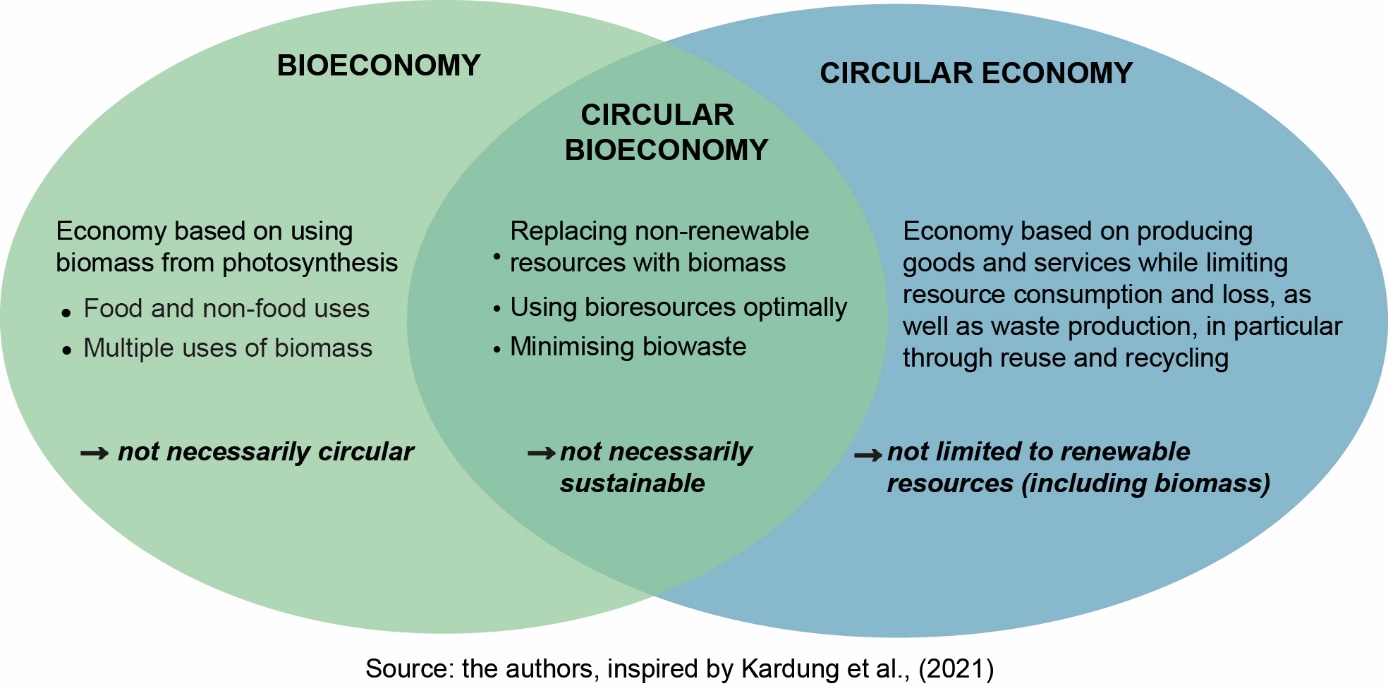
In 2018, the new EU strategy for the bioeconomy emphasised that to be successful it must be based on sustainability and circularity. The concept of a circular bioeconomy (CB) appeared, which combines the concepts of bioeconomy and CE to focus on applying a circular approach to the bioeconomy (Kardung et al., 2021). A CB is not, however, necessarily sustainable (Giampietro, 2019), as described and discussed below. The concepts of bioeconomy, CE, and CB have specific relationships (Figure 1).
Figure 1. Relationships between the bioeconomy, circular economy, and circular bioeconomy.
1.4. Implementing the frameworks
The bioeconomy strategy for France was designed to be implemented in its regions and territories (CGAAER, 2019). The aim was to provide new outlets for the primary sectors (e.g. added value, employment), increase the competitiveness of industries, and provide innovative and more sustainable development solutions to its regions, while reducing dependence on imported raw materials. Although its implementation varied considerably among the regions (CGAAER, 2019), economic stakeholders have used these concepts to promote their activities and show how they respond to the socio-economic and environmental issues promoted by the bioeconomy and CE.
For example, the union for French animal by-product industries (SIFCO) describes the recovery of these by-products as the ‘CE tool’ of livestock sectors, enabling more than three million t of animal biomass to be recovered each year through a variety of processes (40 sites and more than 3,600 jobs). "By preventing these resources from being lost and maximising their added value, it enables us to meet the needs of other industries, potentially as a substitute for other raw materials"
2. Historical perspective
2.1. Major changes in the use of biomass: biomass leaving the economy
Institutions have defined the bioeconomy as "the economy of photosynthesis and more broadly of the living" and "a new vision of the living"
Daviron (2019) reviews the history of biomass (sources and uses) and agriculture (as a source and consumer) since the end of the 16th century. He considers that the uses of biomass were related mainly to the place of biomass in the social metabolism of societies (i.e. in the input of matter and energy) and the relative proportions of food and non-food uses. He drew on research by the Institute of Social Ecology
Box 3. Definitions of the social metabolism of societies and socio-metabolic regime
Social or socio-economic metabolism of societies
Research on the social or socio-economic metabolism of societies has increased, with the aim of placing the economy more firmly within its biophysical substratum and planetary boundaries (Georgescu-Roegen, 1971). This research has different conceptual and disciplinary origins, but all agree on the importance of considering the material and energy bases of societal functioning (Haberl et al., 2019). Social metabolism of societies encompasses the biophysical flows exchanged between societies and their natural environment, as well as flows within and between social systems (Haberl et al., 2019). Importance is attached not only to the flows of matter and energy that pass through societies, but also to their origins and destinations (Fischer-Kowalski and Haberl, 2015). Socio-metabolic approaches, which aim at analysing the social metabolism of societies, seek to connect socio-economic and biophysical processes.
Socio-metabolic regime
Socio-metabolic regimes are specific fundamental models of interactions between human society and nature. A regime is defined by the socio-metabolic profile of the society concerned, in particular its use of materials and energy (Fischer-Kowalski and Haberl, 2007).
There are two socio-metabolic regimes: solar/agrarian and mining/industrial. A society with a solar/agrarian regime depends on biomass almost exclusively as a source of matter and energy (e.g. food, fuel, fibre and hides for clothing, building materials, mechanical energy via animals). Biomass also plays an essential role in maintaining soil fertility. Solar radiation is the main source of primary energy.
A society with a mining/industrial regime derives most of its resources from exploiting the subsoil. Coal, followed by oil, natural gas, and uranium, are nearly the only sources of mechanical and thermal energy. Biomass is replaced by synthetic substitutes or ore derivatives, which abundant energy allows to be extracted and processed. The use of biomass is thus virtually reduced to food. This system also produces large quantities of waste and emissions, especially greenhouse gases (Daviron, 2019). Biomass that was once used is no longer part of the economy, either because it was replaced by fossil resources and synthetic products or because it became unused waste. Lacombe (2018) uses the example of wool, horns, and whey to illustrate how these animal products became 'waste' that had to be disposed of in the specialisation strategy of the mining/industrial regime.
Until 1860, the French economy operated under a solar/agrarian regime, with more than 88% of the materials consumed originating from biomass, whereas from 1980 onwards, biomass represented only 30% of total material consumption (Magalhães et al., 2019). The discovery of the Haber-Bosch process at the beginning of the 20th century accelerated the change in regime, allowing any country with fossil fuels to synthesise nitrogen (N) fertilisers and fertilise the soil without limits, and thus without depending on a local transfer of biomass or a limited and distant physical stock (Daviron, 2019). While the solar/agrarian regime is similar to the bioeconomy, with significant use of biomass as the basis of the economy, the mining/industrial regime has largely moved away from this, with less use of biomass as a source of matter and energy.
2.2. Metabolic breakthroughs: from a circular to a linear economy
Daviron (2019) describes major changes in the relationship with biomass due to the transition from a solar/agrarian to a mining/industrial regime. In addition to the huge increase in agricultural yields, he highlights changes in the metabolic interactions between human activities and the biophysical substrate, which some describe as metabolic ‘ruptures' or ‘rifts' (Saito, 2021). These ruptures concern mainly local transfers of biomass and nutrients (e.g. crop-livestock, town-countryside, forest-crop) and are related to i) specialisation of production systems and value chains; ii) increasing urbanisation and the loss of connections between towns and the nearby countryside (e.g. supplying towns with food, agricultural recycling of urban waste) (Dufour and Barles, 2021); and iii) development of long-distance trade (Le Noë et al., 2018). For example, Daviron (2019) noted that an international soya bean market existed as early as by 1910. Saito (2021) describes three major problems caused by the metabolic ruptures associated with the transition from a circular to a linear economy: depletion of natural resources, transfer of problems from the Global North to the Global South, and delayed climate and environmental impacts.
2.3 Desirable but complex re-uses and recoupling
The bioeconomy requires that non-food uses of biomass regain the importance that they once had in the solar/agrarian regime, and the CE requires recoupling, especially between towns and the countryside, and crops and livestock. The bioeconomy and CE are ultimately about recoupling activities, but doing so is rendered more complex by the loss of processing tools (e.g. the current efforts of the Tricolor Collective
This history of biomass use and metabolic changes (i.e. specialisation, urbanisation, and globalisation of trade) seems invisible to those who promote the bioeconomy/CE, as do the risks of displacing problems and the difficulties of implementation. The dominant 'win-win' discourse, which focuses more on growth and competitiveness (i.e. innovation, employment, and new sectors) than on socio-ecological challenges and glosses over the potential conflicts between economic development and environmental protection (Corvellec et al., 2021), has received strong criticisms from scientists.
The many criticisms has been reviewed, for example by Allain et al. (2022) for the bioeconomy and Corvellec et al. (2021) for the CE. Here, we review the main criticisms and illustrate how they are expressed in livestock sectors, as well as the potential for the livestock sector if these criticisms are addressed.
3. Main criticisms and illustrations for livestock sectors
3.1. Biomass: an inexhaustible and underused resource for the bioeconomy?
Institutions view the bioeconomy as inexhaustible because it is based on biomass, which is renewable by definition, but renewable does not mean sustainable or unlimited.
a. Renewable does not mean sustainable
Institutional descriptions of the potential of the bioeconomy avoid the issue of sustainability (Vivien et al., 2019), particularly for biomass production. Pfau et al. (2014) highlight this conflation of 'renewable' and 'sustainable'. Because the bioeconomy uses renewable resources, it is assumed to be intrinsically sustainable. Sustainability is equated with replacing fossil resources with renewable resources and optimising their use, but using renewable resources does not mean that producing them is sustainable. Cidón et al. (2021) show that little of the scientific literature has focused on the relation between organic farming and the development of the bioeconomy. The focus on biomass can mask the issues of dependence on and use of other resources, particularly natural resources (e.g. water, soil; Staffas et al., 2013), the sustainability of biomass use (e.g. deforestation, soil erosion), and interactions between sectors and diversions of flows (Marty et al., 2021), which is why it is worth taking specific interest in this area (Allain et al., 2022).
Another criticism is the lack of considering social dimensions, which is another component of sustainability. Corvellec et al. (2021) explain the controversies surrounding these policies and strategies, which are presented as 'win-win', but ignore implementation problems, constraints, socio-technical obstacles, losers/winners, and conflicts arising from reorganisation and reorientation of flows and destructurings/restructurings.
Bioeconomic strategies also do not specify the scales at which they will be implemented. They highlight the territorial scale (CGAAER, 2019) without raising questions about the place of territories in industrial rationales. Bahers et al. (2017) discuss the risk that resource-use efficiency will override the territorial dimension. Investment in infrastructure and the need to make it profitable can lead to intensification of production, resulting in the agronomic dead-end of monocultures, an increase in the use of inputs or natural resources (water), diversions of flows that undermine the existing system, or an increase in the disconnect between crops and livestock, as illustrated next.
Illustrations of tensions among territorial, environmental, and industrial considerations
Marty et al. (2021) describe how the use of anaerobic digestion in the north of the Aube department changes crop rotations, irrigation, the return of intermediate crops to the soil, and existing infrastructure and sectors. Beet pulp is increasingly fed into digesters, diverting it from dehydrators, which could cause the latter to close. This would impact the livestock sector, as 350,000-400,000 t of beet pulp and 100,000 t of lucerne are dehydrated in northern Aube and exported as animal feed. The few remaining livestock farms in the region could also disappear. Competition for beet pulp is developing along with anaerobic digestion, which is particularly attractive economically for beet growers. There is also a risk that lucerne will disappear from crop rotations in this crop-oriented department, which would negatively impact the renewal of soil fertility.
At the same time, intermediate crops, including catch crops (not only those used for energy), are increasingly harvested to supply digesters, and less is returned directly to the soil. As intermediate crops become more profitable than main crops, the time spent growing cereals (main crops) has decreased in favour of maize, which requires more irrigation, is now considered an intermediate crop, and is fed whole into digesters. The development of anaerobic digestion has raised several concerns, including the effects on water resources and soil biodiversity of spreading digestate (Madelrieux et al., 2020) and the social acceptability of anaerobic digestion itself (Bourdin and Nadou, 2020).
However, collective-management approaches are developing in response to environmental problems, using an industrial approach that is more firmly rooted in the local area. The Ferti'Eveil composting platforms in the Vendée department are one example. Faced with more stringent environmental regulations (e.g., the EU Nitrates Directive), 15 poultry farmers joined forces in 2006 to pool the management of their poultry manure, in particular by exporting surplus fertilising nutrients outside their production area via composting (Le Houerou and Blazy, 2021). The approach was extended to other types of livestock (i.e. cattle, sheep, goats, and pigs) and in 2021 included 140 farms within 50 km of the two composting platforms. The compost is sold within a 150 km radius to crop farmers, wine growers, market gardeners, and arboriculturists. In return, livestock farmers are supplied with bedding via the cooperative. One key to the success of this long-term approach was the construction of a multi-stakeholder, multi-sector, and multi-scale project. Impacts of the increase in road transport and the energy dimension of the system remain to be determined.
b. Underused does not mean unlimited
The assumption that renewable resources can replace fossil fuels is misleading (Allain et al., 2022) because it does not consider that the current energy transition involves adding renewable resources to fossil fuels (rather than replacing them) and that not all materials have the same properties. For example, biomass has a much lower energy density than fossil fuels (Harchaoui and Chatzimpiros, 2018).
Pahun et al. (2018) showed how institutions have moved from a vision of overexploited resources (through the mining/industrial regime) to underexploited resources (i.e. new uses made possible by technology, agricultural abandonment/fallow land, waste), without changing the regime. There is even a high risk of following a mining approach to the use of biomass, which exacerbates environmental problems and social inequalities. Daviron (2019) considers that biomass is limited, and that the institutional view that it is abundant and underused is due simply to the massive use of fossil fuels in all sectors of human activity. Net primary agricultural production is the product of agricultural yields and available agricultural land, each of which is limited (the former by the conversion efficiency of photosynthesis and the potential yield as a function of farming practices (Mueller et al., 2012), the latter by global boundaries (Steffen et al., 2015)). At the scale of France, the degree to which crop yields and nutrient-use efficiency can be increased is small (Harchaoui and Chatzimpiros, 2019).
At the European scale, Renner et al. (2020) show imbalances between internalisation and externalisation of pressures on agricultural resources and emissions, Europe's dependence on 'virtual' flows of land and water, and the impossibility of extending this model to other parts of the world. With the deployment of the bioeconomy and the increase in demand for biomass, Bruckner et al. (2019) show that an increasing proportion of the world's agricultural land is used to produce biomass for non-food purposes. However, they also show that two-thirds of the agricultural land needed to meet non-food biomass consumption in Europe is located in other countries (i.e. China, United States, and Indonesia), which impacts their ecosystems. This consumption includes oilseeds to produce biofuels, detergents, and polymers, but also more traditional products, such as fibre for textiles and animal hides. In addition, fluctuations in the spatial footprint of consumption highlight the connection to fluctuations in agricultural yields due to drought, which will likely intensify in response to climate change (Harchaoui, 2019).
Competing uses will require more land or more intensive biomass production, whose environmental impacts will depend on the location (Lewandowski, 2015). This competition among uses is rarely studied in a systemic way by the bioeconomy, even though the issue of prioritising biomass uses is unavoidable (Muscat et al., 2021).
Illustrations of tensions among food, feed, and energy
The challenge for agriculture is to produce enough to meet the needs of human and animal consumption, as well as society's bioenergy, without increasing the agricultural area (Harchaoui and Chatzimpiros, 2018). Increasing the area could impact other ecosystems and lead to a loss of biodiversity, another planetary boundary (i.e. ‘biosphere integrity'; Steffen et al., 2015). Many studies ignore that agriculture depends on fossil fuels to produce biomass.
Harchaoui and Chatzimpiros (2018) applied the concept of energy neutrality to describe agriculture's capacity to be a source of energy for itself and society that could replace fossil fuels. Agriculture is energy neutral if the energy potential of its resources (i.e. essentially crop residues and livestock waste) exceeds the biomass equivalent of the fossil fuels invested in it. The study considered several scenarios for mainland France that combined reducing the proportion of cereals and annual fodder in animal feed with different rates of energy recovery from agricultural residues. It found that energy neutrality is difficult to achieve, being possible only if cereals and annual fodder are excluded from animal feed and all agricultural residues have an energy recovery rate of 30-70%. This scenario would decrease the proportion of monogastric animal products in the human diet and run counter to minimum rates of returning crop residues to the soil to meet soil-conservation and carbon-enrichment objectives, leading to dilemmas and compromises between energy and climate objectives (Harchaoui and Chatzimpiros, 2018). This study considered boundary conditions of impacts of competition among food, feed, and energy on agriculture's energy balance, but it did not consider the important practice of reducing food loss and waste to improve the energy balance.
Research is beginning to highlight the role of livestock farming in the recovery of agricultural and agro-industrial co-products (Chapoutot et al., 2018; Van Selm et al. 2022), and more generally of plant biomass that humans cannot consume (Laisse et al., 2018; Van Zanten et al., 2019), in reducing competition between animal feed and human food. Estimates of the co-products available still need to be improved by considering i) their potential use in other sectors (Laisse et al., 2018), such as beet pulp for anaerobic digestion; ii) the energy cost of using them, in particular for dehydration (Lindberg et al., 2021); and iii) the resources needed to change the current economic rationale, develop knowledge and health regulations, and build new value chains and farming practices to create animal feed that contains large proportions of co-products (Laisse et al., 2018), while decreasing health risks for animals (Chapoutot et al., 2018).
3.2. A 100% circular economy?
a. Localised circularities vs. an increase in the size and environmental footprint of the entire system
One criticism of CE concerns its ‘relative' rather than ‘absolute' vision, because if the economy continues to increase in size, the environmental footprints of the flows into and out of it will exceed any gains made by a greater degree of circularity (Haas et al., 2020). Some studies refer to this as "circular washing" (Marrucci et al., 2022), a new way to justify the neoliberal economy. In addition, increasing circularity at one point can increase linearity in the rest of the system and the associated energy and environmental footprints. Indeed, CE is often implemented only in part of a system (Corvellec et al., 2021), as illustrated next.
Potential alliances for monogastric livestock farming in the circular economy
In the Drôme valley of France, a cooperative established a CE model between the crop and poultry sectors to use local cereals better and diversify the income of cereal farmers by developing poultry production, for which there is strong demand and markets for eggs and meat (Madelrieux et al., 2020). The sectors are connected mainly via the feed factory, which receives one-third of the cooperative's cereals, and the poultry manure is used to fertilise the crops. This ‘integrated' poultry sector generates much of the employment in the area. However, according to a life cycle assessment, the crop and poultry production also have the largest impacts on the environment in the territory (e.g. water and energy consumption, potential soil acidification). The poultry sector depends greatly on imports of soya bean and chicks and exports of offal. Poultry slaughterhouses and meat processors export 1,250 t/year of it to the pet-food sector, while the supply cooperative struggles to collect feathers, which are a primary ingredient in N fertilisers manufacturing. Farms' consumption of their own cereals keeps cereal prices higher and absorbs the price fluctuations in poultry production. This local CE model is a way to export poultry and eggs, which are sold through traditional distribution channels, and 50% and 60% of the farms' wheat and maize, respectively, mainly to Italy and North Africa (Madelrieux et al., 2020). This local CE for part of the system, which is strongly promoted by the cooperative, cannot however be isolated from the rest of the system to assess the sustainability of the entire system.
Monogastric animals can serve other functions in a CE by adding value to food waste of the people they help to feed. Uwizeye et al. (2019) investigates replacing cereals and soya bean with lost and wasted food in several pig sectors in Japan. A national incentive policy[12], accompanied by a system of health and economic regulation, enabled the industrial pig sector to establish a value chain for lost and wasted food, whereas many countries restrict such value chains due to the risk of infectious diseases and concerns about public health. In all cases, preventing and reducing loss and waste should always remain the priority (Papargyropoulou et al., 2014).
b. A 100% circular economy is not possible: determining which flows to circularise
Institutions promote ultimately obtaining a 100% CE. Corvellec et al. (2021) highlighted the recurring criticism that promoters of CE ignore established knowledge, in particular that of thermodynamics. The laws of thermodynamics indicate that matter cannot be created or destroyed; it can only change form. Because even cyclic systems consume resources and create waste and emissions (Korhonen et al., 2018), recovery can never be 100%. Thus, a CE future in which waste no longer exists, material cycles are closed, and products are recycled indefinitely is impossible.
Recycling also has time, material, and financial costs, as it involves internalising costs that previously fell on the environment through the accumulation of waste (Giampietro, 2019). The additional energy required to operate a CE thus requires switching to renewable energy (Haas et al., 2020), with the difficulties associated with replacing energy sources mentioned previously.
Another issue is which flows should be circularised (Giampietro, 2019). Dourmad et al. (2019) mention flows to and from livestock farming (e.g. animal feed, human food, livestock waste). Flows and transfers can compete (i.e. increasing the circularity of one flow can decrease the efficiency with which another flow is used) (Van der Wiel et al., 2020), which highlights the issue of the scale at which one should aim for 100% circularity, as illustrated next for areas with high livestock density.
Flows that can be circularised in areas with high-density livestock farming
Rothwell et al. (2020) raise questions about the merits of a CE in areas with high livestock density. They investigate vulnerabilities of the agri-food system in Northern Ireland due to the supply of phosphorus (P) (i.e. risk of disrupted supplies and inflation of input prices) and its inefficient use (i.e. water pollution and impacts on biodiversity and human health). They show that the spatial and temporal distribution of P from manure is critical for the sustainability of agriculture in Northern Ireland. Its combination of locally intensive livestock production, limited availability of arable land, high cost of transporting manure, limited infrastructure for treating manure, and 57% of land classified as high risk for run-off poses significant challenges to farmers for balancing agronomic and environmental objectives. Increasing the circularity of P can improve the sustainability of P management and reduce losses, with the aim of a zero P balance. However, for regions with high livestock density, there is a trade-off between P circularity and surplus; in Northern Ireland, the P load of manure on the soil exceeds the P demand of crops by 20% (Rothwell et al., 2020). Recovering P from the waste-management sector to increase P circularity would only add to the P load already circulating in the system, thereby increasing the risk of surpluses and losses due to run-off.
Scenarios have been discussed to address this paradox, in which livestock farming can help reduce the vulnerability of crops to disruptions in the supply of synthetic fertilisers, but also has high environmental impacts (Martin-Ortega et al., 2022). They involve a variety of mechanisms and stakeholders: using economically viable technologies to treat livestock waste for easier export to areas with a deficit; relying more on the soil's past P heritage and existing reserves and meeting only the minimum crop requirements; aiming for an environmental target (1.5 kg/ha) and modifying P flows from fertilisers, animal feed, manure, and the waste-management sector accordingly; and reducing livestock populations, along with decreasing human consumption of animal products. Discussions with stakeholders will help identify socio-economic, logistical, and technological obstacles and needs.
3.3. Circular bioeconomy: can resource use and economic growth be decoupled?
Institutional visions of the bioeconomy/CE are based on the idea that resource use can be decoupled from economic growth, which is criticised as another misleading assumption (Allain et al., 2022). One argument against this idea is the rebound effect, or Jevons' paradox, which states that optimising the use of resources counter-intuitively leads to over-exploiting them (Alcott, 2005), as Jevons originally observed for coal[13].
Sorrell (2009) identifies different dimensions of the rebound effect: the interplay of supply and demand (i.e. technological innovation, improvement in the efficiency of a process, lower production cost, increased demand for the product, incentive to produce more, greater use of the initial resource) and the intention behind the increase in efficiency (e.g. decrease environmental impacts, lower costs). The rebound effect is often related to economic motivations (e.g. depletion of fossil fuels, price increases) rather than socio-ecological motivations, as we illustrate next for crop-livestock recoupling.
Rebound effect in crop-livestock recoupling
Recoupling crop and livestock production by exchanging materials within mixed farming systems is an effective way to close nutrient cycles. However, as farms are becoming increasingly specialised, one option is to recouple specialised farms at the territorial scale (Regan et al., 2017). In theory, this recoupling should result in using fewer synthetic fertilisers on crop farms and having less surplus N on livestock farms. However, this assumption is not always valid due to the rebound effect, as highlighted by Regan et al. (2017) for recoupling of crop and dairy production via cooperation between farms.
Based on four case studies of crop-livestock-recoupling strategies in Europe, Regan et al. (2017) found that the newly available resources in three of them facilitated adoption of more intensive farming practices on cooperating specialised dairy farms than on non-cooperating ones. In Spain, for example, material exchanges between crop and dairy farms and access to more land on which to spread surplus manure allowed the dairy farms to increase herd size and double the stocking rate, which decreased the benefits of cooperation (e.g. having less surplus N/ha). As the increase in the stocking rate was related to the ability to manage manure and not the ability to produce cattle feed, larger volumes of concentrated feed and fodder were imported to support the dairy farms. However, Regan et al. (2017) were unable to determine whether cooperation helped farmers to intensify their systems or was necessary to maintain systems that were already intensive.
In contrast, other studies of conventional and organic livestock farms (Martel et al., 2017) show that i) farms with a high degree of coupling have better environmental performance and economic efficiency, ii) organic farms have an above-average degree of coupling (to compensate for the lack of synthetic chemicals), and iii) effects of coupling and converting to organic farming are cumulative. Thus, the rebound effect does not always occur.
These results indicate the need to consider crop-livestock-recoupling strategies that replace purchased inputs, which impact the environment, with local resources (e.g. manure, feed) and to consider potential rebound effects. These effects will be even larger if crop-livestock recoupling is used to increase stocking rates and total livestock production rather than to reduce inputs to the entire system.
4. Discussion: priorities for a sustainable circular bioeconomy and the role of livestock farming
4.1. Rematerialising thought: socio-metabolic approaches
Based on this historical perspective, metabolic ruptures lie at the heart of the current energy and environmental crises, which raises questions about the linearisation/circularisation of matter and energy flows. These flows and their circulation are largely hidden by the globalisation of trade (Nesme et al., 2018), environmental footprints or climate effects that are sometimes distant in space or time, and flows that humans try to hide, such as waste (Monsaingeon, 2017).
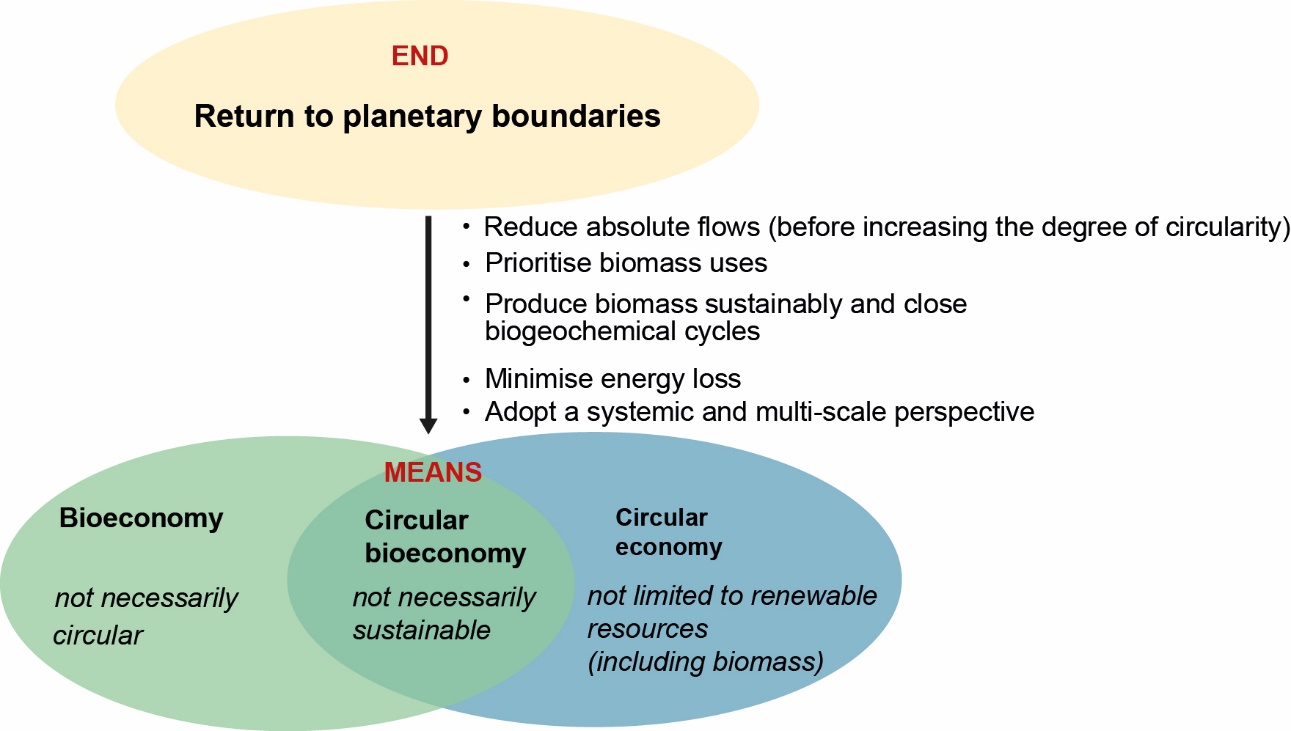
There is thus a strong need to reintegrate the economy, and social systems more broadly, into their biophysical substratum and planetary boundaries (Georgescu-Roegen, 1971). Doing so requires highlighting how socio-metabolic relationships, technological solutions, production systems, economic models, and environmental/energy footprints co-evolve (Åkerman et al., 2020). For livestock farming, which consumes, processes, and supplies large quantities of bioresources (i.e. all assets for the bioeconomy), Dourmad et al. (2019) emphasise the need for more information about existing flows and the factors that influence them in order to be able to manage them, especially due to the high spatial variability in the related flows (e.g. diversity of livestock species and production systems, geographic distribution, location of upstream and downstream agri-food sectors), which results in exchanges between regions. Based on this socio-metabolic perspective, Haas et al. (2020) suggested priorities for the bioeconomy/CE/CB to effectively transform systems to return them to planetary boundaries (Figure 2).
Figure 2. The bioeconomy, circular economy, and circular bioeconomy as means, not ends.
4.2. Priorities for integrating livestock farming into the social metabolism of agri-food systems
a. Considering biomass as a limited resource and the bioeconomy/circular bioeconomy as a way to reduce the social metabolism
As mentioned, although renewable, biomass is far from unlimited. Biomass use and access to land already experience high competition. The bioeconomy, CE, and CB should be seen not as ends, but as means to an end: an absolute reduction in the social metabolism in order to return the economy to planetary boundaries (Haas et al., 2020). Institutions view the bioeconomy and CE as ends in themselves and do not consider the variety of mechanisms that could promote development of strong sustainability (Allwood, 2014).
The first challenge is to prioritise the absolute reduction of flows (i.e. resource-extraction inputs and emission outputs) before increasing circularity rates, which must be supported by clear targets to limit and monitor all non-circular extraction, emission, and waste flows (Haas et al., 2020). Absolute indicators that enable comparing the social metabolism to planetary boundaries should be the reference point for assessing transition options (Allain et al., 2022).
The second challenge is to prioritise biomass uses to limit competition for it. As mentioned, competition between animal feed and human food (Schader et al., 2015) is especially important. One major challenge for livestock farming is thus to reduce the inputs required for production (Dumont et al., 2013). Karlsson et al. (2021) show that 23% of the land used to grow feed for livestock in Europe is located outside Europe, and 90% of this land is used to produce soya beans. Reducing the flows associated with animal feed means primarily reducing livestock density, particularly where they are highest.
For prioritising biomass uses and limiting competition with human food, one benefit of livestock farming is its ability to use biomass that humans cannot consume (Laisse et al., 2018), such as grass for ruminants, food waste for monogastric animals, and co-products of agro-industries. Some studies question the place of livestock farming in sustainable food systems (Röös et al., 2017) that can meet dietary recommendations while considering planetary boundaries (Van Selm et al., 2022).
Nutrient loss to the environment is another flow that must be reduced. In a recent analysis, more than one-third of global anthropogenic N pollution is attributed to livestock farming, a quantity that exceeds planetary boundaries for N emissions (Uwizeye et al., 2020). However, livestock farming helps maintain soil fertility, which limits the need for synthetic fertilisers (Van Hal et al., 2019). Ruminants, in particular, play a key role in circulating N by converting the N fixed in grassland to crops. In France, the N fixed by forage legumes in grassland represents more than 80% of total biological N fixation (Einarsson et al., 2021), but only ruminants can use this N for agricultural production.
An absolute reduction in animal density and stocking rates seems necessary (Billen et al., 2021), but it must be accompanied by more even spatial distribution of livestock and a recoupling of crops and livestock. This reduction/redistribution can be based on the local animal-feed resources available (Dourmad et al., 2019), the land available for spreading livestock manure, or the potential to export it to nearby areas that have a deficit and depend on synthetic fertilisers (Nesme et al., 2015).
b. Renewable and sustainable
Most institutions view agriculture as a supplier of inputs and biomass, and rarely refer to the conditions under which biomass is produced and the natural resources required to produce it (i.e. a ‘factory gate' view; Wohlfahrt et al., 2019). To avoid continuing the mining/industrial regime, which risks further disruption of biogeochemical cycles and loss of biodiversity, sustainable production of biomass must become a prerequisite in CB strategies (Haas et al., 2020), in particular by moving towards agriculture based as much as possible on solar energy, without synthetic inputs and little mechanisation, as well as respecting natural cycles (Georgescu-Roegen, 1971).
The issue is whether organic farming can develop at a large scale without abandoning its ecological principles (Nesme et al., 2016) and replace conventional farming while still being able to feed the humanity. A large N deficit at the global scale could limit its expansion, and it implies making structural changes to feed the world in a more sustainable and equitable way (Barbieri et al., 2021). According to Barbieri et al. (2021), livestock farming is the key to maintaining food production, but it must be redesigned to maintain crop yields and thus food production. Their model for optimising global N flows predicts that the global livestock population would decrease by 20% in a 100% organic scenario. These results differ greatly from those of studies that focus on expanding organic farming by drastically decreasing the number of livestock in order to maintain food availability but that ignore livestock's important role as a source of nutrients. In contrast, Barbieri et al. (2021) show that global food availability would decrease in a 100% organic world without livestock, emphasising that livestock in organic farming have a much more important and complex role than previously estimated. The scenario also implies a strong shift in livestock production towards ruminants (confirming their role in circulating N, as mentioned) and changes to the cropping systems and spatial distribution of livestock production found in the current conventional baseline scenario. On the demand side, this scenario also requires changing diets, reducing food waste, and recycling urban waste in agriculture.
c. A systematic energy perspective to avoid counter-productive effects of bioeconomy/circular economy strategies
The bioeconomy and CE are intended to reduce dependence on fossil fuels, but they can involve energy-intensive processes and recycle much less than a 100%. Furthermore, if the bioeconomy and CE are to contribute to absolute reductions in emissions to limit climate change, a systematic energy perspective seems necessary to avoid counter-productive effects of both strategies (Haas et al., 2020).
Trade-offs among the multiple uses of biomass must be analysed from a systemic viewpoint by considering the closing of biogeochemical cycles and the energy functioning of agriculture, both of which are strongly influenced by livestock sectors. As livestock have an energy conversion efficiency of less than 1 (Harchaoui and Chatzimpiros, 2017), they influence agriculture's energy balance, but livestock manure can be used to fertilise crops and generate energy if it is highly integrated into cropping systems. Further studies are needed to assess the role of livestock farming, differentiating between ruminants and monogastric animals depending on the region, in the circularity of nutrient flows and the energy neutrality of agriculture (Harchaoui and Chatzimpiros, 2018), and especially on the trade-offs between biogeochemistry and energy (Harchaoui, 2019). Studies could also analyse the spatial organisation of animal and material flows between territories (Le Noë et al., 2016) and focus on decreasing the consumption of non-renewable energy for transport to help build sustainable agri-food systems.
d. Multi-scale socio-metabolic networks
Dumont et al. (2013) emphasise that reducing the environmental footprint of livestock farming systems requires coordinating complementarities between agroecology (i.e. production based more on natural resources and biological diversity) and industrial ecology/CE (i.e. to close cycles, reduce demand for raw materials, reduce pollution, and treat waste). Scenarios of the compatibility of the social metabolism of agri-food systems with planetary boundaries or energy neutrality (Billen et al., 2021; Duru et al., 2021) have identified key variables for production as well as for demand and waste treatment. These variables include production methods (especially organic); crop rotations and their proportions of legumes (which fix N in the soil and are a protein source for humans) and grasslands (carbon sequestration); recoupling crops and livestock; human diets (proportion of animal products); animal diets (proportion of grass and other non-human-edible ingredients); recycling of livestock and human waste; reconnection of production and consumption and the role of international trade; and the use in agriculture and energy of products and by-products from crop farming, livestock farming, agro-industries, and food losses and waste.
As seen in the illustrations described previously, limiting flows, footprints, and competing uses requires addressing these variables at all scales, from individual farms or companies to the scales of regional, national, and global trade (Haas et al., 2020). At the global scale, Bruckner et al. (2019) suggest monitoring land use and displacement effects in detail to support the sustainable development of global bioeconomy strategies. Dourmad et al. (2019) suggest considering efficiency rates at different scales of organisation to support the development of a CB based on the diversity of practices and resources in territories, particularly for livestock farming. Research has revealed differences among regions in animal feed and the ability to recouple crops and livestock (Jouven et al., 2018), the distribution of livestock waste and its availability to crops (Nesme et al., 2015), the availability of co-products (Chapoutot et al., 2018), and the use of anaerobic digestion (FranceAgriMer, 2022). These differences require spatially explicit approaches to consider interactions between biophysical and socio-economic processes and to better identify the role of livestock sectors (Spiegal et al., 2022) to envision reconnections between geographically close territories.
Besides the urgent and high-priority decisions explored in scenarios, the remaining challenges include the necessary reorganisations and existing obstacles. For livestock farming, Dourmad et al. (2019) show that cycle-closing strategies may be effective but have many socio-technical, organisational, and economic obstacles. Accurately predicting potential transfers, rebound effects, and socio-technical obstacles requires considering production practices and consumption patterns as well as all stakeholders in the sectors, interactions among sectors, and the resulting extensive socio-metabolic networks (Allain et al., 2022).
Conclusion
Since the 2000s, the bioeconomy and CE have emerged on political and research agendas in Europe. Institutions promote them based on misleading shortcuts that have received strong criticism from scientists, particularly related to the lack of questions about or evidence of a connection between the bioeconomy/CE and sustainability. Nevertheless, these shortcuts suggest the opposite: renewable, sustainable, and unlimited for the bioeconomy, and circular, closed, and waste-free for the CE.
Livestock farming is an asset for the CB due to its consumption, processing, and supply of large quantities of biomass, as well as its diversity. It is surprising, however, that its place in more circular and sustainable agri-food systems has received little attention. The necessary transformations require socio-metabolic, systemic, and multi-scale approaches that consider production, consumption, and waste management. While the bioeconomy and CE alone cannot return the economy to planetary boundaries, they can be a means, along with other mechanisms (e.g. agroecology, public policies, regulations) of doing so if the criticisms of them are addressed.
The role of public policy will be decisive. At present, public policy is ambiguous and even contradictory. Some policies promote competitiveness and the free market by relying on large-scale industries, whereas others encourage relocalisation and local development. The first set of policies concentrates operators, which results in the loss of infrastructure at the local scale, undermining attempts to re-establish local bioeconomies or more CE. Consistent strategies and choices among multiple scales (e.g. national, regional, local) seem essential to reorganise or even maintain local infrastructure, and then to encourage all stakeholders to move in the same sustainable direction.
Acknowledgements
The authors thank the members of the 'Bioeconomy and territories: limits and reorganisation of agricultural and food systems' working group of INRAE's ACT Department; ADEME for its funding of the projects Boat, AF Filières (2016 GRAINE programme) and Scalable (2019 GRAINE programme); and the participants in these projects, who contributed to the discussions in this article. The authors also thank the reviewers for INRAE Productions Animales and the ‘Rencontres Recherches Ruminants’, who helped to improve the manuscript, in particular by clarifying the concepts of the bioeconomy, circular economy, and circular bioeconomy, and the potential of livestock farming.
This article was translated using www.DeepL.com/Translator by the journal and then sent to the authors for proofreading. Finally, the authors thank Michelle and Michael Corson for English-language editing and their valuable comments. The 2021 Scientific Installation Allowance research programme of Rennes Metropole (no. 21C0694) helped pay for the English-language editing.
Notes
- This article is based on an invited presentation at the 26th “Rencontres Recherches Ruminants”, 7-8 December 2022 (Madelrieux et al., 2022).
- https://agriculture.gouv.fr/une-strategie-bioeconomie-pour-la-france-plan-daction-2018-2020
- https://agriculture.gouv.fr/telecharger/95176
- https://environment.ec.europa.eu/topics/circular-economy_enhttps://www.sifco.fr/
- https://www.lacooperationagricole.coop/media/4373/download
- https://agriculture.gouv.fr/la-bioeconomie-nouvelle-vision-du-vivant
- https://boku.ac.at/en/wiso/sec/research/gesellschaftlicher-stoffwechsel
- https://www.collectiftricolor.org/
- https://idele.fr/spicee/https://www.gis-avenir-elevages.org/actions-thematiques/reconnexion-vegetal-elevage-reve
- In Japan, the law on food recycling came into force in 2007. It requires food-waste producers to recycle their food waste into compost, animal feed, or biogas, or to efficiently use the heat from incinerating it. It also requires the food sector to purchase agricultural products that used products derived from food waste, such as compost and animal feed. On the producer side, a specific ‘Ecofeed’ label is being developed with special prices to encourage pig farmers to use feed with recycled ingredients.
- Increased efficiency in the use of coal was due to technical improvements in steam engines, which rather than reducing coal consumption, increased it and thus increased environmental impacts.
References
- Åkerman M., Humalisto N., Pitzenc S., 2020. Material politics in the circular economy: The complicated journey from manure surplus to resource. Geoforum, 116. doi:10.1016/j.geoforum.2020.07.013
- Alcott B., 2005. Jevons’ paradox. Ecol. Econ., 54, 9‑21. doi:10.1016/j.ecolecon.2005.03.020
- Allain S., Ruault J.F., Moraine M., Madelrieux S., 2022. The ‘bioeconomics vs bioeconomy’ debate : Beyond criticism, advancing research fronts. Environ. Innov., Societal Transitions, 42, 58-73. doi:10.1016/j.eist.2021.11.004
- Allwood J., 2014. Squaring the Circular Economy: The role of recycling within a hierarchy of material management strategies. In Handbook of recycling. Worrel E., Reuter M. (Eds.). Elsevier, 445-477. doi:10.1016/B978-0-12-396459-5.00030-1
- Bahers J.B., Durand M., Beraud H., 2017. Quelle territorialité pour l’économie circulaire ? Interprétation des typologies de proximité dans la gestion des déchets. Flux, 109/110, 129-141. doi:10.3917/flux1.109.0129
- Barbieri P., Pellerin S., Seufert V., Smith L., Ramankutty N., Nesme T., 2021.Global option space for organic agriculture is delimited by nitrogen availability. Nature Food, 2, 363-372. doi:10.1038/s43016-021-00276-y
- Billen G., Aguilera E., Einarsson R., Garnier J., Gingrich S., Grizzetti B., Lassaletta L., Le Noë J., Sanz-Cobena A., 2021. Reshaping the European agro-food system and closing its nitrogen cycle: The potential of combining dietary change, agroecology, and circularity. One Earth 4, 839-850. doi:10.1016/j.oneear.2021.05.008
- Bourdin S., Nadou F., 2020. The role of a local authority as a stakeholder encouraging the development of biogas: A study on territorial intermediation. J. Environ. Manage., 258. doi:10.1016/j.jenvman.2019.110009
- Bruckner M., Häyhä T., Giljum S., Maus V., Fischer G., Tramberend S., Börner J., 2019. Quantifying the global cropland footprint of the European Union’s nonfood bioeconomy. Environ. Res. Lett., 14, 4. doi:10.1088/1748-9326/ab07f5
- Chapoutot P., Rouillé B., Sauvant D., Renaud B., 2018. Les coproduits de l’industrie agro-alimentaire : des ressources alimentaires de qualité à ne pas négliger. Dossier, Ressources alimentaires pour les animaux d’élevage. Baumont R. (Éd). INRA Prod. Anim., 31, 201-220. doi:10.20870/productions-animales.2018.31.3.2353
- CGAAER, 2019. Place des régions dans le développement de la bioéconomie. Rapport CGAAER n° 18109, 110p. https://agriculture.gouv.fr/place-des-regions-dans-le-developpement-de-la-bioeconomie-0
- Cidón C.F, Figueiró P.S., Schreiber D., 2021. Benefits of organic agriculture under the perspective of the bioeconomy: A Systematic Review. Sustainability, 13. doi:10.3390/su13126852
- Corvellec H., Stowell A., Johansson N., 2021. Critiques of the circular economy. J. Ind. Ecol., 1-12. doi:10.1111/jiec.13187
- Daviron B., 2019. Biomasse. Une histoire de richesse et de puissance. Éditions Quae, Versailles, France, 392p.
- Dourmad J.Y., Guilbaud T., Tichit M., Bonaudo T., 2019. Les productions animales dans la bioéconomie : Dossier : De grands défis et des solutions pour l’élevage. Mauguin Ph. (Éd). INRA Prod. Anim., 32, 205-220. doi:10.20870/productions-animales.2019.32.2.2485
- Dumont B., Fortun-Lamothe L., Jouven M., Thomas M., Tichit M., 2013. Prospects from agroecology and industrial ecology for animal production in the 21st century. Animal, 7, 1028-1043. doi:10.1017/S1751731112002418
- Einarsson R., Sanz-Cobena A., Aguilera E., Billen G., Garnier J., van Grinsven H.J.M., Lassaletta L., 2021. Crop production and nitrogen use in European cropland and grassland 1961–2019. Nature Sci. Data, 8, 288. doi:10.1038/s41597-021-01061-z
- Fischer-Kowalski M., Haberl H., 2007. Socioecological transitions and global change: Trajectories of Social Metabolism and Land Use. Edward Elgar Publishing, Cheltenham, UK, 288p. doi:10.4337/9781847209436
- Fischer-Kowalski M., Haberl H., 2015. Social metabolism: A metric for biophysical growth and degrowth. In: Handbook of Ecological Economics. Martínez-Alier J., Muradian R. (Eds). 100-138. Edward Elgar Publishing, Cheltenham, UK. doi:10.4337/9781783471416.00009
- FranceAgriMer, 2013. Étude sur la valorisation du 5e quartier des filières bovine, ovine et porcine en France. Les études de FranceAgriMer, 16p.
- FranceAgriMer, 2022. Ressources en biomasse et méthanisation agricole : quelles disponibilités pour quels besoins ? Analyse des données théoriques de l’ONRB. Les études de FranceAgriMer, 23p.
- Georgescu-Roegen N., 1971. The Entropy Law and the Economic Process. Harvard University Press, Cambridge, USA, 469p. doi:10.4159/harvard.9780674281653
- Giampietro M., 2019. On the Circular Bioeconomy and Decoupling: implications for Sustainable Growth. Ecol. Econ., 162, 143‑156. doi:10.1016/j.ecolecon.2019.05.001
- Haas W., Krausmann F., Wiedenhofer D., Lauk C., Mayer A., 2020. Spaceship earth’s odyssey to a circular economy. A century long perspective. Resour. Conserv. Recycl., doi:163. 10.1016/j.resconrec.2020.105076
- Haberl H., Wiedenhofer D., Pauliuk S., Krausmann F., Müller D.B, Fischer-Kowalski M., 2019. Contributions of sociometabolic research to sustainability science. Nat. Sustain. 2. doi:10.1038/s41893-019-0225-2
- Harchaoui S., 2019. Modélisation des transitions en agriculture : énergie, azote, et capacité nourricière de la France dans la longue durée (1882-2016) et prémices pour une généralisation à l'échelle mondiale. Thèse de l'Université Paris Cité, France. 265p. https://theses.hal.science/tel-02940384/document
- Harchaoui S., Chatzimpiros P., 2017. Reconstructing production efficiency, land use and trade for livestock systems in historical perspective. The case of France, 1961–2010. Land Use Policy, 67, 378-386. doi:10.1016/j.landusepol.2017.05.028
- Harchaoui S., Chatzimpiros P., 2018. Can Agriculture Balance Its Energy Consumption and Continue to Produce Food? A Framework for Assessing Energy Neutrality Applied to French Agriculture. Sustainability, 10. doi:10.3390/su10124624
- Harchaoui S., Chatzimpiros P., 2019. Energy, Nitrogen, and Farm Surplus Transitions in Agriculture from Historical Data Modeling. France, 1882–2013. J. Indust. Ecol., 23, 412-425. doi:10.1111/jiec.12760
- Jouven M., Puillet L., Perrot C., Pomeon T., Dominguez J.P., Bonaudo T., Tichit M., 2018. Quels équilibres végétal/animal en France métropolitaine, aux échelles nationales et petite région agricole ? INRA Prod. Anim., 31, 353-364. doi:10.20870/productions-animales.2018.31.4.2374
- Kardung M., Cingiz K., Costenoble O., Delahaye R., Heijman W., Lovri´c M., Leeuwen M.V., M’Barek R., Meijl H.V., Piotrowski S., Ronzon T., Sauer J., Verhoog D., Verkerk P.J., Vrachioli M., Wesseler J..H.H., Zhu B.X., 2021. Development of the Circular Bioeconomy: Drivers and Indicators. Sustainability, 13, 1, 413. https://www.mdpi.com/2071-1050/13/1/413
- Karlsson J.O., Parodi A., van Zanten H.H.E., Hansson P.A., Röös E., 2021. Halting European Union soybean feed imports favours ruminants over pigs and poultry. Nature Food, 2, 38-46. doi:10.1038/s43016-020-00203-7
- Kirchherr J., Reike D., Hekkert M., 2017. Conceptualizing the circular economy: An analysis of 114 definitions. Resources Conserv. Recycl., 127, 221-232. doi:10.1016/j.resconrec.2017.09.005
- Korhonen J., Honkasalo A., Seppälä J., 2018. Circular Economy: The Concept and its Limitations. Ecol. Econ.,143. doi:10.1016/j.ecolecon.2017.06.041
- Lacombe N., 2018. Co-produire. Repenser l’élevage par les interdépendances entre activités. Géocarrefour. doi:10.4000/geocarrefour.11230
- Laisse S., Baumont R., Dusart L., Gaudré D., Rouillé B., Benoit M., Veysset P., Rémond D., Peyraud J.L., 2018. L’efficience nette de conversion des aliments par les animaux d’élevage : une nouvelle approche pour évaluer la contribution de l’élevage à l’alimentation humaine : Dossier : Ressources alimentaires pour les animaux d’élevage. Baumont R. (Éd). INRA Prod. Anim., 31, 3, 269-288. doi:10.20870/productions-animales.2018.31.3.2355
- Le Houerou A., Blazy V., 2021. Fertil’Eveil, une expérience de gestion commune des effluents. Réussir Volailles. https://www.reussir.fr/volailles/fertileveil-une-experience-de-gestion-commune-des-effluents
- Le Noë J., Billen G., Lassaletta L., Silvestre M., Garnier J., 2016. La place du transport de denrées agricoles dans le cycle biogéochimique de l’azote en France : un aspect de la spécialisation des territoires. Cah. Agricult., 25, 1, 15004. doi:10.1051/cagri/2016002
- Le Noë J., Billen G., Esculier F., Garnier J., 2018. Long-term socioecological trajectories of agro-food systems revealed by N and P flows in French regions from 1852 to 2014. Agric. Ecosyst. Environ., 265, 132-143. doi:10.1016/j.agee.2018.06.006
- Levidow L., Birch K., Papaioannou T., 2013. Divergent Paradigms of European Agro-Food Innovation: The Knowledge-Based Bio-Economy (KBBE) as an R&D Agenda. Science Technology Human Values, 38, 1, 94-125. doi:10.1177/0162243912438143
- Lewandowski I., 2015. Securing a Sustainable Biomass Supply in a Growing Bioeconomy. Global Food Security, 34‑42. doi:10.1016/j.gfs.2015.10.001
- Lindberg M., Henriksson M., Bååth Jacobsson S., Berglund Lundberg M., 2021. Byproduct-based concentrates in Swedish dairy cow diets – evaluation of environmental impact and feed costs. Acta Agriculturae Scandinavica, 113, 132-144. doi:10.1080/09064702.2021.1976265
- Madelrieux S., Grilllot M., Dermine-Brullot S., Marty P., Godinot O., Ruault J.F., Chatzimpiros P., Gabriel A., Buclet N., Lescoat P., 2020. Biomasses d’origine agricole à l’échelle de territoires. Quelles formes de gestion et valorisation : entre cloisonnement, concurrence ou intégration ? Rapport final du projet Boat, Ademe, 58p.
- Madelrieux S., Courtonne J.Y., Grillot M., Harchaoui S., 2022. Bioéconomie et économie circulaire : lecture critique et place de l’élevage. In : 26e édition du Congrès international francophone Renc. Rech. Ruminants, Paris, France, 7-8 décembre 2022. http://www.journees3r.fr/spip.php?article5112
- Magalhães N., Fressoz J.-B., Jarrige F., Le Roux T., Levillain G., Lyautey M., Noblet G., Bonneuil C., 2019. The Physical Economy of France (1830–2015). The History of a Parasite? Ecol. Econ., 157, 291-300. doi:10.1016/j.ecolecon.2018.12.001
- Marrucci L., Corcelli F., Daddi T., Iraldo F., 2022. Using a life cycle assessment to identify the risk of “circular washing” in the leather industry. Resources, Conservation & Recycling, 185. doi:10.1016/j.resconrec.2022.106466
- Martel G., Guilbert C., Veysset P., Dieulot R., Durant D., Mischler P., 2017. Mieux coupler cultures et élevage dans les exploitations d’herbivores conventionnelles et biologiques : une voie d’amélioration de leur durabilité ? Fourrages, 231,235-245.
- Martin-Ortega J., Rothwell S.A., Anderson A., Okumah M., Lyon C., Sherry E., Johnston C., Withers P.J.A., Doody D.G., 2022. Are stakeholders ready to transform phosphorus use in food systems? A transdisciplinary study in a livestock intensive system. Environ. Sci. Policy, 131, 177-187. doi:10.1016/j.envsci.2022.01.011
- Marty P., Dermine-Brullot S., Madelrieux S., Fleuet J., Lescoat P., 2021. Transformation of socioeconomic metabolism due to development of the bioeconomy: the case of northern Aube (France). Eur. Plan. Stud. doi:10.1080/09654313.2021.1889475
- Monsaingeon B., 2017. Homo Detritus. Éditions du Seuil, Coll. Anthropocène, Paris, France, 279 p.
- Mottet A., de Haan C., Falcuccia A., Tempio G., Opio C., Gerber P., 2017. Livestock: On our plates or eating at our table? A new analysis of the feed/food debate. Global Food Security, 14, 1-8. doi:10.1016/j.gfs.2017.01.001
- Mueller N.D., Gerber J.S., Johnston M., Ray D.K., Ramankutty N., Foley J.A., 2012. Closing yield gaps through nutrient and water management. Nature, 490, 254-257. doi:10.1038/nature11420
- Muscat A., de Olde E.M., Ripoll-Bosch R., Van Zanten H. E., Metze T.A.P., Termeer C.J.A.M. Ittersum M.K.V., de Boeret I.J.M., 2021. Principles, drivers and opportunities of a circular bioeconomy. Nature Food, 2, 561-566. doi:10.1038/s43016-021-00340-7
- Nesme T., Senthilkumar K., Mollier A., Pellerin S., 2015. Effects of crop and livestock segregation on phosphorus resource use: A systematic, regional analysis. European J. Agron., 71, 88-95. doi:10.1016/j.eja.2015.08.001
- Nesme T., Nowak B., David C., Pellerin S., 2016. L’Agriculture Biologique peut-elle se développer sans abandonner son principe d'écologie ? Le cas de la gestion des éléments minéraux fertilisants. Innov. Agron., 51, 57-66. doi:10.15454/1.4721176631543018E12
- Nesme T., Metsone G.S., Bennett E.M., 2018. Global phosphorus flows through agricultural trade. Glob. Environ. Chang., 50, 133-141. Principles, drivers and opportunities of a circular bioeconomy. Nature Food, 2, 561-566. doi:10.1016/j.gloenvcha.2018.04.004
- Pahun J., Fouilleux `E., Daviron B., 2018. De quoi la bioéconomie est-elle le nom ? Genèse d’un nouveau référentiel d’action publique. Natures Sci. Soc., 26, 3‑16. doi:10.1051/nss/2018020
- Papargyropoulou E., Lozano R., Steinberger J. K., Wright N., bin Ujang Z., 2014. The food waste hierarchy as a framework for the management of food surplus and food waste. J. Clean. Prod., 76, 106-115. doi:10.1016/j.jclepro.2014.04.020
- Pfau S., Hagens J., Dankbaar B., Smits A., 2014. Visions of Sustainability in Bioeconomy Research. Sustainability, 6, 1222-1249. doi:10.3390/su6031222
- Regan J.T., Marton S., Barrantes O., Ruane E., Hanegraaf M., Berland J., Korevaar H., Pellerin S., Nesme T., 2017. Does the recoupling of dairy and crop production via cooperation between farms generate environmental benefits? A case-study approach in Europe. Eur. J. Agron., 82, 342‑356. doi:10.1016/j.eja.2016.08.005
- Renner A., Cadillo-Benalcazar J.J., Benini L., Giampietro M., 2020. Environmental pressure of the European agricultural system: anticipating the biophysical consequences of internalization. Ecosyst. Serv., 46. doi:10.1016/j.ecoser.2020.101195
- Röös E., Bajželj B., Smith P., Patel M., Little D., Garnett T., 2017. Greedy or needy? Land use and climate impacts of food in 2050 under different livestock futures. Glob. Environ. Chang., 47, 1-12. doi:10.1016/j.gloenvcha.2017.09.001
- Rothwell S.A., Doody D.G., Johnston C., Forber K.J., Cencic O., Rechberger H., Withers P.J.A., 2020. Phosphorus stocks and flows in an intensive livestock dominated food system. Resources Conservation Recycling, 163. doi:10.1016/j.resconrec.2020.105065
- Saito K., 2021. La théorie du métabolisme chez Marx à l’ère de la crise écologique mondiale. Tracés, 40. doi:10.4000/traces.12425
- Schader C., Muller A., Scialabba N.E.H., Hecht J., Isensee A., Erb K.H., Smith P., Harinder P.S. Makkar P.K., Leiber F., Schwegler P., Stolze M., Urs N., 2015. Impacts of feeding less food-competing feedstuffs to livestock on global food system sustainability. J.R. Soc. Interface 12. doi:10.1098/rsif.2015.0891
- Sorrell S., 2009. Jevons’ Paradox revisited: the evidence for backfire from improved energy efficiency. Energy policy, 37, 4. doi:10.1016/j.enpol.2008.12.003
- Spiegal S., Vendramini J.M.B., Bittman S., Silveira M.L., Gifford C., Rotz C.A., Ragosta J.P., Kleinman P.J.A., 2022. Recycling nutrients in the beef supply chain through circular manuresheds: Data to assess tradeoffs. J. Env. Quality, 51, 494-509. doi:10.1002/jeq2.20365
- Staffas L., Gustavsson M., McCormick K., 2013. Strategies and Policies for the Bioeconomy and Bio-Based Economy: An Analysis of Official National Approaches. Sustainability, 5, 2751-2769. doi:10.3390/su5062751
- Steffen W., Richardson K., Rockström J., Cornell S.E., Fetzer, I., Bennett E.M., Biggs R., Carpenter S.R., de Vries W., de Wit C.A., Folke C., Gerten D., Heinke J., Mace G.M., Persson L.M., Ramanathan V., Reyers B., Sörlin S., 2015. Planetary boundaries: Guiding human development on a changing planet. Science, 347. doi:10.1126/science.1259855
- Uwizeye A., Gerber P.J., Opio C.I., Tempio G., Mottet A., Makkar H.P.S., Falcucci A., Steinfeld H., de Boer I.J.M., 2019. Nitrogen flows in global pork supply chains and potential improvement from feeding swill to pigs. Resources Conservation & Recycling, 146, 168-179. doi:10.1016/j.resconrec.2019.03.032
- Uwizeye A., de Boer I.J.M., Opio C.I., Schulte R.P.O Falcucci A., Tempio G., Teillard F., Casu F., Rulli J., Galloway, J.N., Leip A., Erisman J. W., Robinson T.P., Steinfeld H., Gerber P.J., 2020. Nitrogen emissions along global livestock supply chains. Nature Food, 1, 437-446. doi:10.1038/s43016-020-0113-y
- Van der Wiel B.Z., Weijma J., van Middelaar C.E., Kleinke M., Buisman C.J.N., Wichern F., 2020 Restoring nutrient circularity: A review of nutrient stock and flow analyses of local agro-food-waste systems. Resources Conservation & Recycling. doi:10.1016/j.resconrec.2020.104901
- Van Hal O., de Boer I.J.M., Muller A., de Vries S., Erb K.H., Schader C., Gerrits W.J.J., van Zanten H.H.E., 2019. Upcycling food leftovers and grass resources through livestock: Impact of livestock system and productivity. J. Clean. Prod., 219, 485–496. doi:10.1016/j.jclepro.2019.01.329
- Van Selm B., Frehner A., de Boer I.J.M., van Hal O., Hijbeek R., van Ittersum M.K., Talsma E.F., Lesschen J.P., Hendriks C.M.J., Herrero M., van Zanten H.H.E., 2022. Circularity in animal production requires a change in the EAT-Lancet diet in Europe. Nature Food, 3, 66-73. doi:10.1038/s43016-021-00425-3
- Van Zanten H.H.E., van Ittersum M.K., de Boer I.J.M., 2019. The role of farm animals in a circular food system. Global Food Security, 21, 18-22. doi:10.1016/j.gfs.2019.06.003
- Vivien F.D., Nieddu M., Befort N., Debref R., Giampietro M., 2019. The Hijacking of the Bioeconomy. Ecol. Econ., 159, 189‑197. doi:10.1016/j.ecolecon.2019.01.027
- Wohlfahrt J., Ferchaud F., Gabrielle B., Godard C., Kurek B., Loyce C., Therond O., 2019. Characteristics of bioeconomy systems and sustainability issues at the territorial scale. A review. J. Clean. Prod., 232, 898‑909. doi:10.1016/j.jclepro.2019.05.385
Abstract
Bioeconomy and circular economy have become key strategies in Europe since the 2000s, in order to shift away from fossil energy. Agriculture is at the heart of multiple issues: food, health, energy, biomaterials... While some agree that bioeconomy and circular economy have a significant potential to contribute to the sustainable development goals and the Paris climate Agreement, there are many critics, especially because of the lack of questioning or evidence of the links between bioeconomy/circular economy and sustainability. Here, we start from the institutional definitions of these two concepts to position the main criticisms that are made of them, but also the potentials. We will consider examples from the livestock sectors. We use criticism as a tool to unpack hidden assumptions and unanticipated consequences, and to re-evaluate what might otherwise be taken for granted, in order to discuss priorities so that bioeconomy and circular economy can be real means of achieving a sustainable society, and the place that livestock sectors can hold in it.
Attachments
No supporting information for this articleArticle statistics
 Views: 6194
Downloads
 PDF: 262
 XML: 80
Most read articles by the same author(s)
- Manon SAILLEY, Cécile CORDIER, Jean-Yves COURTONNE, Boris DUFLOT, François CADUDAL, Christophe PERROT, Aude BRION, René BAUMONT, Quantification and segment flows of raw material used in animal feed in France , INRAE Productions Animales: Vol. 34 No. 4 (2021)
- Lucile MONTAGNE, Laurent ALIBERT, Cécile BONNEFONT, Jean-Philippe CHOISIS, Amandine DURPOIX, Hélène GILBERT, Souhil HARCHAOUI, Catherine LARZUL, Bénédicte LEBRET, Sarah LOMBARD, Gilles MARTEL, Marc MORAINE, Laurent PICGIRARD, Thomas PUECH, Justine FAURE, What are the challenges for the development of organic pig production in France? , INRAE Productions Animales: Vol. 37 No. 2 (2024): Special issue: Organic livestock farming: conditions and potential for development